
Power Crunch Triple Chocolate
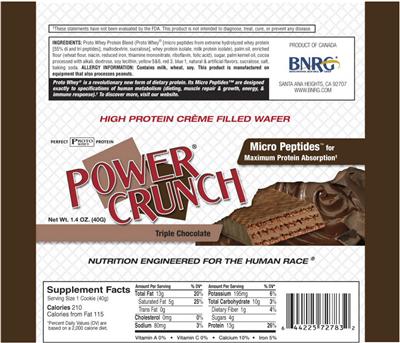
| Calories | 210 {Calories} | |
| Calories from Fat | 115 {Calories} | |
| Total Fat | 13 g | 20% |
| Saturated Fat | 5 g | 25% |
| Trans Fat | 0 g | |
| Cholesterol | 0 g | 0% |
| Sodium | 80 mg | 3% |
| Potassium | 195 mg | 6% |
| Total Carbohydrates | 10 g | 3% |
| Dietary Fiber | 1 g | 4% |
| Sugar | 4 g | |
| Protein | 13 g | 26% |
| Vitamin A | 0% | |
| Vitamin C | 0% | |
| Calcium | 10% | |
| Iron | 5% |
Other ingredients: Proto Whey Protein Blend, Palm Oil, enriched Flour, Sugar, Palm kernel Oil, Cocoa, Dextrose, Soy Lecithin, Yellow 5&6, Red 3, Blue 1, Natural & Artificial flavors, Sucralose, Salt, Baking Soda
% Daily Values for: Adults and children 4 or more years of age.
Where this label comes from
An original label of the NIH's Dietary Supplement Label Database, entered there on 25 November 2011, shown here as it was entered. The NIH's record
General information
- Product name
- Power Crunch Triple Chocolate
- Brand
- BNRG Bionutritional Research Group
- Barcode (UPC)
- 6 44225 72783 2
- Net contents
- 1.4 oz.; 40 Gram(s)
- Market status
- On market
- DSLD ID
- 2228
Classification
- Supplement form
- Other (e.g. tea bag)
- Product type
- Other Combinations
- Claim types on the label
- Nutrient, All Other, Structure/Function
- Intended for
- Adult (18 - 50 Years)
Label statements
Precautions: Allergies: ALLERGY INFORMATION: Contains milk, wheat, soy. This product is manufactured on equipment that also processes peanuts.
Brand information
Manufacturer: BNRG Bionutritional Research Group, Santa Ana Heights, CA
More labels from BNRG Bionutritional Research Group
Labels only: each label is shown as printed on the bottle, with no grades, rankings or advice. A label in this database is not an endorsement of the product. Read the label on the bottle you buy: makers change their formulas. Reverse Age Lab is not affiliated with, or endorsed by, the National Institutes of Health or its Office of Dietary Supplements. The original labels come from the NIH’s public-domain data; the labels since are read by us. Search the Dietary Supplement Label Database.