
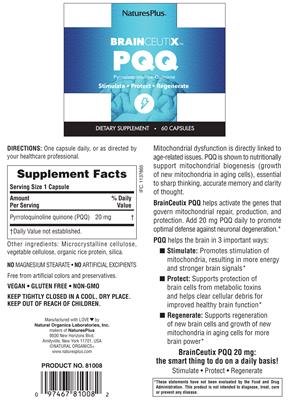
| Pyrroloquinoline Quinone | 20 mg | † |
Other ingredients: Microcrystalline Cellulose, Vegetable Cellulose, organic Rice Protein, Silica
% Daily Values for: Adults and children 4 or more years of age.
Where this label comes from
An original label of the NIH's Dietary Supplement Label Database, entered there on 24 June 2020, shown here as it was entered. The NIH's record
General information
- Product name
- PQQ
- Brand
- Natures Plus BrainCeutix
- Barcode (UPC)
- 0 97467 81008 2
- Net contents
- 60 Capsule(s)
- Market status
- Off market
- DSLD ID
- 223517
Classification
- Supplement form
- Capsule
- Product type
- Non-Nutrient/Non-Botanical
- Claim types on the label
- All Other, Structure/Function
- Intended for
- Vegan, Vegetarian, Adult (18 - 50 Years), Gluten Free
Label statements
Formula: Contains: Pyrroloquinoline Quinone
FDA Statement of Identity: Dietary Supplement
Directions: Directions: One capsule daily, or as directed by your healthcare professional.
Formulation: Does NOT Contain: No magnesium stearate No artificial excipients Free from artificial colors and preservatives. Gluten free Non-GMO
Storage: Keep tightly closed in a cool, dry place.
Precautions: Children: Keep out of reach of children.
Formula: Contains: BrainCeutix PQQ helps activate the genes that govern mitochondrial repair, production, and protection. Add 20 mg PQQ daily to promote optimal defense against neuronal degeneration.
Formula: Contains: BrainCeutix PQQ 20 mg: the smart thing to do on a daily basis!
Brand information
Manufactured with love by: Natural Organics Laboratories, Inc. makers of Nature's Plus, Amityville, New York, USA
More labels from Natures Plus BrainCeutix
Labels only: each label is shown as printed on the bottle, with no grades, rankings or advice. A label in this database is not an endorsement of the product. Read the label on the bottle you buy: makers change their formulas. Reverse Age Lab is not affiliated with, or endorsed by, the National Institutes of Health or its Office of Dietary Supplements. The original labels come from the NIH’s public-domain data; the labels since are read by us. Search the Dietary Supplement Label Database.