
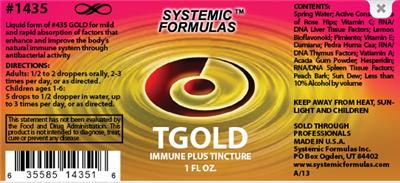
| spring Water | ||
| Active Constituents of (as Acacia Gum Powder, Less than Alcohol, Damiana, Hesperidin, Lemon Bioflavonoid, Peach, Pedra Huma Caa, Pimiento, RNA/DNA Liver Tissue Factors, RNA/DNA Spleen Tissue Factors, RNA/DNA Thymus Factors, Rose Hips, Sun Dew, Vitamin A, Vitamin C, Vitamin E)Active Constituents of (Form: Rose Hips, Vitamin C, RNA/DNA Liver Tissue Factors, Lemon Bioflavonoid, Pimiento, Vitamin E, Damiana, Pedra Huma Caa, RNA/DNA Thymus Factors, Vatiamin A CorrectedName: Vitamin A, Acacia Gum Powder, Hesperidin, RNA/DNA Spleen Tissue Factors, Peach PlantPart: Bark, Sun Dew, Less than 10% Alcohol Note: by volume) |
% Daily Values for: Adults and children 4 or more years of age.
Where this label comes from
An original label of the NIH's Dietary Supplement Label Database, entered there on 25 July 2013, shown here as it was entered. The NIH's record
General information
- Product name
- TGold Immune Plus Tincture
- Brand
- Systemic Formulas
- Barcode (UPC)
- 6 35585 14351 6
- Net contents
- 1 fl. Oz.
- Market status
- On market
- DSLD ID
- 22433
Classification
- Supplement form
- Liquid
- Product type
- Other Combinations
- Claim types on the label
- All Other, Structure/Function
- Intended for
- Adult (18 - 50 Years)
Label statements
Directions: DIRECTIONS: Adults: 1/2 to 2 droppers orally, 2-3 times a day, or as directed. Children ages 1-6: 5 drops to 1/2 dropper in water, up to 3 times per day, or as directed.
Storage: KEEP AWAY FROM HEAT, SUN-LIGHT AND CHILDREN.
Precautions: Children: KEEP AWAY FROM HEAT, SUN-LIGHT AND CHILDREN.
Brand information
Manufacturer: Systemic Formulas Inc., Ogden, Utah
More labels from Systemic Formulas
Labels only: each label is shown as printed on the bottle, with no grades, rankings or advice. A label in this database is not an endorsement of the product. Read the label on the bottle you buy: makers change their formulas. Reverse Age Lab is not affiliated with, or endorsed by, the National Institutes of Health or its Office of Dietary Supplements. The original labels come from the NIH’s public-domain data; the labels since are read by us. Search the Dietary Supplement Label Database.