
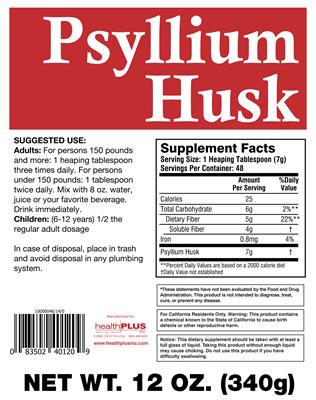
| Calories | 25 | |
| Total Carbohydrates | 6 g | 2% |
| Dietary Fiber | 5 g | 22% |
| Soluble Fiber | 4 g | † |
| Iron | 0.8 mg | 4% |
| Psyllium | 7 g | † |
% Daily Values for: Adults and children 4 or more years of age.
Where this label comes from
An original label of the NIH's Dietary Supplement Label Database, entered there on 24 June 2020, shown here as it was entered. The NIH's record
General information
- Product name
- Psyllium Husk
- Brand
- Health Plus
- Barcode (UPC)
- 0 83502 40120 9
- Net contents
- 12 oz.; 340 Gram(s)
- Market status
- Off market
- DSLD ID
- 229026
Classification
- Supplement form
- Powder
- Product type
- Fiber and Other Nutrients
- Claim types on the label
- All Other
- Intended for
- Children 4 or More Years of Age, Adult (18 - 50 Years)
Label statements
Directions: Suggested use: Adults: For persons 150 pounds and more: 1 heaping tablespoon three times daily. For persons under 150 pounds: 1 tablespoon twice daily. Mix with 8 oz. water, juice or your favorite beverage. Drink immediately. Children: (6-12 years) 1/2 the regular adult dosage
Precautions: All Other: In case of disposal, place in trash and avoid disposal in any plumbing system.
Precautions: All Other: For California Residents Only. Warning: This product contains a chemical known to the State of California to cause birth defects or other reproductive harm. Notice: This dietary supplement should be taken with at least a full glass of liquid. Taking this product without enough liquid may cause choking. Do not use this product if you have difficulty swallowing.
Brand information
Manufactured by: health PLUS inc, CHINO, CA, U.S.A.
More labels from Health Plus
Labels only: each label is shown as printed on the bottle, with no grades, rankings or advice. A label in this database is not an endorsement of the product. Read the label on the bottle you buy: makers change their formulas. Reverse Age Lab is not affiliated with, or endorsed by, the National Institutes of Health or its Office of Dietary Supplements. The original labels come from the NIH’s public-domain data; the labels since are read by us. Search the Dietary Supplement Label Database.