
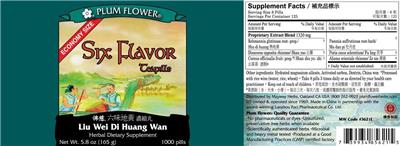
| Proprietary Extract Blend | 1,320 mg | |
| Rehmannia glutinosa root- prep. extract | † | |
| Dioscorea opposita extract | † | |
| Cornus officinalis fruit- prep. extractCornus officinalis fruit- prep. extract (Alt. Name: Shan zhu yu- zhi) PlantPart: fruit Genus: Cornus Species: officinalis Note: Processed with rice wine(water, rice, wheat) | † | |
| Paeonia suffruticosa extract | † | |
| Poria cocos extract | † | |
| Alisma orientalis extract | † |
Other ingredients: hydrated Magnesium Silicate, activated Carbon, Dextrin, China Wax
% Daily Values for: Adults and children 4 or more years of age.
Where this label comes from
An original label of the NIH's Dietary Supplement Label Database, entered there on 23 July 2020, shown here as it was entered. The NIH's record
General information
- Product name
- Six Flavor Teapills
- Brand
- Plum Flower
- Barcode (UPC)
- 7 39934 85621 5
- Net contents
- 1000 Pill(s); 5.8 Ounce(s); 165 Gram(s)
- Market status
- Off market
- DSLD ID
- 229657
Classification
- Supplement form
- Tablet or Pill
- Product type
- Other Combinations
- Claim types on the label
- All Other
- Intended for
- Adult (18 - 50 Years)
Label statements
FDA Statement of Identity: Herbal Dietary Supplement
Formulation: Does NOT Contain: No pharmaceuticals or dyes Unsulfured, preservative-free herbs when available
Directions: Take 8 pills 3 times daily or as directed by your health care practitioner
Precautions: Children: Keep out of reach of children.
Brand information
Distributed by: Mayway Herbs, Oakland, CA, USA
More labels from Plum Flower
Labels only: each label is shown as printed on the bottle, with no grades, rankings or advice. A label in this database is not an endorsement of the product. Read the label on the bottle you buy: makers change their formulas. Reverse Age Lab is not affiliated with, or endorsed by, the National Institutes of Health or its Office of Dietary Supplements. The original labels come from the NIH’s public-domain data; the labels since are read by us. Search the Dietary Supplement Label Database.