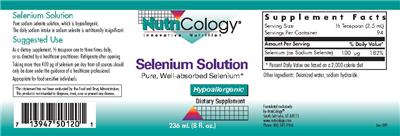
| Selenium (as Sodium Selenite)Selenium (Form: as Sodium Selenite) | 100 mcg | 182% |
Other ingredients: deionized Water, Sodium Hydroxide
% Daily Values for: Adults and children 4 or more years of age.
Where this label comes from
An original label of the NIH's Dietary Supplement Label Database, entered there on 25 September 2020, shown here as it was entered. The NIH's record
General information
- Product name
- Selenium Solution
- Brand
- NutriCology
- Barcode (UPC)
- 7 13947 50120 1
- Net contents
- 236 mL; 8 fl. Oz.
- Market status
- On market
- DSLD ID
- 234756
Classification
Label statements
Formula: Contains: Pure Sodium Selenite Solution, which is hypoallergenic. The daily sodium intake in sodium selenite is nutritionally insignificant.
Directions: Suggested Use As a dietary supplement, 1/2 teaspoon one to three times daily, or as directed by a healthcare practitioner.
Storage: Refrigerate after opening.
Precautions: All Other: Taking more than 400 mcg of Selenium per day from all sources should only be done under the guidance of a healthcare professional.
Formula: Contains: Pure, well-absorbed Selenium
Formula: Contains: Dietary Supplement
Brand information
Formulated exclusively for: NutriCology, South Salt Lake, UT
More labels from NutriCology
Labels only: each label is shown as printed on the bottle, with no grades, rankings or advice. A label in this database is not an endorsement of the product. Read the label on the bottle you buy: makers change their formulas. Reverse Age Lab is not affiliated with, or endorsed by, the National Institutes of Health or its Office of Dietary Supplements. The original labels come from the NIH’s public-domain data; the labels since are read by us. Search the Dietary Supplement Label Database.