
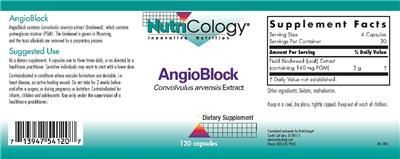
| Field Bindweed (leaf) extract | 2 g | † |
| PGM | 140 mg |
Other ingredients: Gelatin, Maltodextrin
% Daily Values for: Adults and children 4 or more years of age.
Where this label comes from
An original label of the NIH's Dietary Supplement Label Database, entered there on 25 September 2020, shown here as it was entered. The NIH's record
General information
- Product name
- AngioBlock
- Brand
- NutriCology
- Barcode (UPC)
- 7 13947 54120 7
- Net contents
- 120 Capsule(s)
- Market status
- On market
- DSLD ID
- 235395
Classification
Label statements
Formula: Contains: AngioBlock contains Convolvulus arvensis extract (bindweed), which contains proteoglycan mixture (PGM).
Formulation: Does NOT Contain: The bindweed is grown in Wyoming, and the toxic alkaloids are removed by a proprietary process.
Directions: Suggested Use As a dietary supplement, 4 capsules one to three times daily, or as directed by a healthcare practitioner. Sensitive individuals may want to start with a lower dose.
Precautions: All Other: Contraindicated in conditions where vascular formations are desirable, i.e. heart disease, an active healing wound.
Precautions: Pregnant or Nursing or Prescription Medications: Do not take for 2 weeks before and after a surgery, or during pregnancy or lactation.
Precautions: Children: Contraindicated for infants, children and adolescents.
Precautions: All Other: Use only under the supervision of a healthcare practitioner.
Formula: Contains: Convolvulus arvensis extract
FDA Statement of Identity: Dietary Supplement
Storage: Keep in a cool, dry place, tightly capped.
Precautions: Children: Keep out of reach of children.
Brand information
Formulated exclusively for: NutriCology, South Salt Lake, UT
More labels from NutriCology
Labels only: each label is shown as printed on the bottle, with no grades, rankings or advice. A label in this database is not an endorsement of the product. Read the label on the bottle you buy: makers change their formulas. Reverse Age Lab is not affiliated with, or endorsed by, the National Institutes of Health or its Office of Dietary Supplements. The original labels come from the NIH’s public-domain data; the labels since are read by us. Search the Dietary Supplement Label Database.