
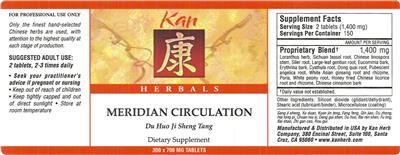
| Proprietary Blend | 1,400 mg | |
| Loranthus | ||
| Sichuan Teasel | ||
| Chinese Tinospora | ||
| Siler | ||
| Large-leaf Gentian | ||
| Eucommia | ||
| Erythrina | ||
| Cyathula | ||
| Dong Quai | ||
| Pubescent Angelica | ||
| White Asian Ginseng | ||
| Poria | ||
| White Peony | ||
| honey fried Chinese Licorice | ||
| Chinese Cinnamon |
Other ingredients: Silicon Dioxide, Stearic Acid, Microcellulose
% Daily Values for: Adults and children 4 or more years of age.
Where this label comes from
An original label of the NIH's Dietary Supplement Label Database, entered there on 22 January 2021, shown here as it was entered. The NIH's record
General information
- Product name
- Meridian Circulation
- Brand
- Kan
- Barcode (UPC)
- Not printed
- Net contents
- 300 700 mg Tablet(s)
- Market status
- On market
- DSLD ID
- 240209
Classification
- Supplement form
- Tablet or Pill
- Product type
- Other Combinations
- Claim types on the label
- All Other, Structure/Function
- Intended for
- Adult (18 - 50 Years)
Label statements
Directions: Suggested Adult Use: 2 tablets, 2-3 times daily
Precautions: Pregnant or Nursing or Prescription Medications: Seek your practitioner's advice if pregnant or nursing
Precautions: Children: Keep out of reach of children
Storage: Keep tightly capped and out of direct sunlight Store at room temperature
FDA Statement of Identity: Dietary Supplement
Formula: Contains: Sang ji sheng, Xu duan, Kuan jin teng, Fang feng, Qin jiao, Du zhong, Hai tong pi, Chuan niu xi, Dang gui shen, Du huo, Bai ren shen, Fu ling, Bai shao, Zhi gan cao, Rou gui
Brand information
Manufactured & Distributed in the USA by: Kan Herb Company, Santa Cruz, CA
Labels only: each label is shown as printed on the bottle, with no grades, rankings or advice. A label in this database is not an endorsement of the product. Read the label on the bottle you buy: makers change their formulas. Reverse Age Lab is not affiliated with, or endorsed by, the National Institutes of Health or its Office of Dietary Supplements. The original labels come from the NIH’s public-domain data; the labels since are read by us. Search the Dietary Supplement Label Database.