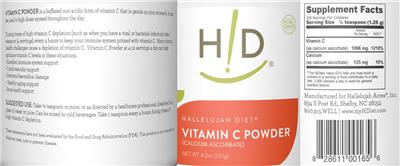
| Vitamin C (as Calcium Ascorbate)Vitamin C (Form: as Calcium Ascorbate) | 1,096 mg | 1,218% |
| Calcium (as Calcium Ascorbate)Calcium (Form: as Calcium Ascorbate) | 125 mg | 10% |
% Daily Values for: Adults and children 4 or more years of age.
Where this label comes from
An original label of the NIH's Dietary Supplement Label Database, entered there on 26 December 2020, shown here as it was entered. The NIH's record
General information
- Product name
- Vitamin C Powder
- Brand
- H!D Hallelujah Diet
- Barcode (UPC)
- 8 28611 00165 6
- Net contents
- 4.2 Ounce(s); 120 Gram(s)
- Market status
- On market
- DSLD ID
- 240476
Classification
- Supplement form
- Powder
- Product type
- Single Vitamin and Mineral
- Claim types on the label
- Nutrient, All Other, Structure/Function
- Intended for
- Adult (18 - 50 Years)
Label statements
Formula: Contains: Vitamin C Powder is a buffered non-acidic form of vitamin C that is gentle on your stomach.
Directions: It can be used in high doses spread throughout the day. During times of high vitamin C depletion (such as when you have a viral or bacterial infection) take 1 teaspoon (4 servings) every 4 hours to keep your immune system primed with vitamin C. Many chronic health challenges cause a depletion of vitamin C. Vitamin C Powder at 4-12 servings a day can help optimize vitamin C levels in these situations.
Directions: Suggested Use: Take 1/4 teaspoon or more, or as directed by a healthcare professional, dissolved in a glass of water or juice. Can be mixed in cold beverages. Take 1 teaspoon every 4 hours during times of high vitamin C depletion.
Formula: Contains: (Calcium Ascorbate)
Brand information
Manufactured for: Hallelujah Acres, Inc., Shelby, NC
More labels from H!D Hallelujah Diet
Labels only: each label is shown as printed on the bottle, with no grades, rankings or advice. A label in this database is not an endorsement of the product. Read the label on the bottle you buy: makers change their formulas. Reverse Age Lab is not affiliated with, or endorsed by, the National Institutes of Health or its Office of Dietary Supplements. The original labels come from the NIH’s public-domain data; the labels since are read by us. Search the Dietary Supplement Label Database.