
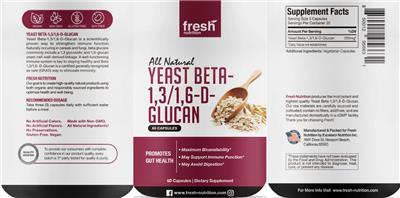
| Yeast Beta-1,3/1,6-D-Glucan | 200 mg | † |
Other ingredients: Vegetarian Capsules
% Daily Values for: Adults and children 4 or more years of age.
Where this label comes from
An original label of the NIH's Dietary Supplement Label Database, entered there on 25 February 2021, shown here as it was entered. The NIH's record
General information
- Product name
- Yeast Beta-1,3/1,6-D-Glucan
- Brand
- Fresh Nutrition
- Barcode (UPC)
- 8 50012 95663 1
- Net contents
- 60 Capsule(s)
- Market status
- On market
- DSLD ID
- 241906
Classification
- Supplement form
- Capsule
- Product type
- Fiber and Other Nutrients
- Claim types on the label
- Nutrient, All Other, Structure/Function
- Intended for
- Vegan, Vegetarian, Adult (18 - 50 Years), Gluten Free
Label statements
Formulation: Does NOT Contain: Non GMO Gluten free Soy free
Formula: Contains: Yeast Beta-1,3/1,6-D-Glucan Yeast Beta-1,3/1,6-D-Glucan is a scientifically proven way to strengthen immune function. Naturally occurring in cereals and fungi, beta glucans commonly include a 1,3 glycosidic and 1,6-glucan yeast-cell-wall-derived linkage. A well-functioning immune system is key to staying healthy and Beta 1,3/1,6-D-Glucan is a certified generally recognized as safe (GRAS) way to stimulate immunity.
Directions: Recommended Dosage Take three (3) capsules daily with sufficient water before a meal.
Formulation: Does NOT Contain: No artificial colors. No artificial flavors. No preservatives. Made with Non-GMO, all natural ingredients!
FDA Statement of Identity: Dietary Supplement
Brand information
Manufactured & Packed for: Fresh Nutrition by Excelsior Nutrition Inc., Newport Beach, California
More labels from Fresh Nutrition
Labels only: each label is shown as printed on the bottle, with no grades, rankings or advice. A label in this database is not an endorsement of the product. Read the label on the bottle you buy: makers change their formulas. Reverse Age Lab is not affiliated with, or endorsed by, the National Institutes of Health or its Office of Dietary Supplements. The original labels come from the NIH’s public-domain data; the labels since are read by us. Search the Dietary Supplement Label Database.