
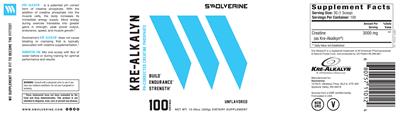
| Creatine (as Kre-Alkalyn)Creatine (Form: as Kre-Alkalyn) | 3,000 mg | † |
% Daily Values for: Adults and children 4 or more years of age.
Where this label comes from
An original label of the NIH's Dietary Supplement Label Database, entered there on 25 February 2021, shown here as it was entered. The NIH's record
General information
- Product name
- Kre-Alkalyn Unflavored
- Brand
- Swolverine
- Barcode (UPC)
- 6 80757 11012 4
- Net contents
- 10.58 Ounce(s); 300 Gram(s)
- Market status
- On market
- DSLD ID
- 242037
Classification
- Supplement form
- Powder
- Product type
- Non-Nutrient/Non-Botanical
- Claim types on the label
- All Other, Structure/Function
- Intended for
- Vegan, Vegetarian, Adult (18 - 50 Years), Women (not pregnant or lactating)
Label statements
Formula: Contains: Kre-Alkalyn is a patented pH correct form of creatine phosphate. With the addition of creatine phosphate into the muscle cells, the body increases its immediate energy supply. More energy during exercise translates into greater gains in strength, peak power output, endurance, speed, and muscle growth.
Directions: Suggested Use: Mix one scoop with 8oz of water before or during training for optimal performance and results.
Precautions: All Other: Warning: Consult with a physician prior to use if you have any medical conditions.
Precautions: Pregnant or Nursing or Prescription Medications: Do not use if pregnant or lactating.
Formula: Contains: PH-Corrected Creatine Phosphate
FDA Statement of Identity: Dietary Supplement
Formulation: Does NOT Contain: Non GMO
Brand information
Manufactured for: Swolverine, Spokane Valley, WA
More labels from Swolverine
Labels only: each label is shown as printed on the bottle, with no grades, rankings or advice. A label in this database is not an endorsement of the product. Read the label on the bottle you buy: makers change their formulas. Reverse Age Lab is not affiliated with, or endorsed by, the National Institutes of Health or its Office of Dietary Supplements. The original labels come from the NIH’s public-domain data; the labels since are read by us. Search the Dietary Supplement Label Database.