
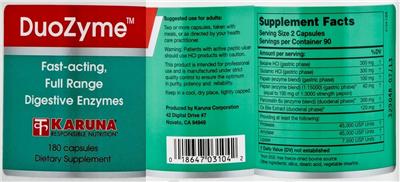
| Betaine HClBetaine HCl Note: gastric phase | 300 mg | † |
| Glutamic Acid HydrochlorideGlutamic HCl Note: gastric phase | 300 mg | † |
| PapainPapain Note: (enzyme blend) (gastric phase) | 100 mg | † |
| PepsinPepsin Note: (enzyme blend) (1:15000) (gastric phase from BSE-free freeze-dried source) (equal to 100 mg of 1:3000 strength pepsin) | 40 mg | † |
| PancreatinPancreatin Note: (6x) (enzyme blend) (duodenal phase) (from BSE-free freeze-dried source) | 300 mg | † |
| Ox Bile extractOx Bile extract Note: (duodenal phase) (from BSE-free freeze-dried source) | 120 mg | † |
| Providing at least the following | ||
| Protease | 45,000 USP Unit | † |
| Amylase | 45,000 USP Unit | † |
| Lipase | 7,500 USP Unit | † |
Other ingredients: Silica, Stearic Acid, Vegetable Stearine
% Daily Values for: Adults and children 4 or more years of age.
Where this label comes from
An original label of the NIH's Dietary Supplement Label Database, entered there on 23 August 2013, shown here as it was entered. The NIH's record
General information
- Product name
- DuoZyme
- Brand
- Karuna
- Barcode (UPC)
- 0 18647 03104 2
- Net contents
- 180 Capsule(s)
- Market status
- Off market
- DSLD ID
- 24365
Classification
- Supplement form
- Capsule
- Product type
- Non-Nutrient/Non-Botanical
- Claim types on the label
- All Other
- Intended for
- Adult (18 - 50 Years)
Label statements
FDA Statement of Identity: Dietary Supplement
Directions: Suggested use for adults: Two or more capsules, taken with meals, or as directed by your health care practitioner.
Precautions: All Other: Warning: Patients with active peptic ulcer should use HCl products with caution.
Storage: Keep in a cool, dry place, tightly capped.
Brand information
Produced by: Karuna Corporation, Novato, CA
More labels from Karuna
Labels only: each label is shown as printed on the bottle, with no grades, rankings or advice. A label in this database is not an endorsement of the product. Read the label on the bottle you buy: makers change their formulas. Reverse Age Lab is not affiliated with, or endorsed by, the National Institutes of Health or its Office of Dietary Supplements. The original labels come from the NIH’s public-domain data; the labels since are read by us. Search the Dietary Supplement Label Database.