
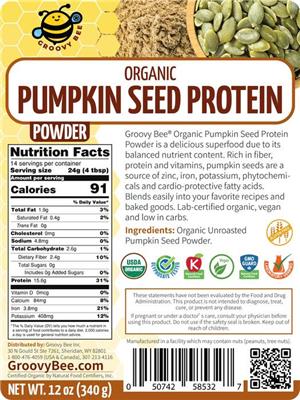
| Calories | 91 | |
| Total Fat | 1.9 g | 3% |
| Saturated Fat | 0.4 g | 2% |
| Trans Fat | 0 g | |
| Cholesterol | 0 mg | 0% |
| Sodium | 4.8 mg | 0% |
| Total Carbohydrates | 2.6 g | 1% |
| Dietary Fiber | 2.4 g | 10% |
| Total Sugars | 0 g | |
| Added Sugars | 0 g | 0% |
| Protein | 15.6 g | 31% |
| Vitamin D | 0 mcg | 0% |
| Calcium | 84 mg | 8% |
| Iron | 3.8 mg | 21% |
| Potassium | 408 mg | 12% |
Other ingredients: organic Unroasted Pumpkin seed powder
% Daily Values for: Adults and children 4 or more years of age.
Where this label comes from
An original label of the NIH's Dietary Supplement Label Database, entered there on 25 February 2021, shown here as it was entered. The NIH's record
General information
- Product name
- Organic Pumpkin Seed Protein
- Brand
- Groovy Bee
- Barcode (UPC)
- 0 50742 58532 7
- Net contents
- 12 Ounce(s); 340 Gram(s)
- Market status
- On market
- DSLD ID
- 244047
Classification
Label statements
Formula: Contains: Rich in fiber, protein and vitamins, pumpkin seeds are a source of zinc, iron, potassium, phytochemicals and cardio-protective fatty acids.
Directions: Blends easily into your favorite recipes and baked goods.
Formulation: Does NOT Contain: Gluten Free
Precautions: Pregnant or Nursing or Prescription Medications: If pregnant or under a doctor's care, consult your physician before using this product.
Precautions: All Other: Do not use if safety seal is broken.
Precautions: Children: Keep out of reach of children.
Precautions: Allergies: Manufactured in a facility which may contain nuts (peanuts, tree nuts).
Brand information
Distributed by: Groovy Bee Inc, Sheridan, WY, USA
More labels from Groovy Bee
Labels only: each label is shown as printed on the bottle, with no grades, rankings or advice. A label in this database is not an endorsement of the product. Read the label on the bottle you buy: makers change their formulas. Reverse Age Lab is not affiliated with, or endorsed by, the National Institutes of Health or its Office of Dietary Supplements. The original labels come from the NIH’s public-domain data; the labels since are read by us. Search the Dietary Supplement Label Database.