
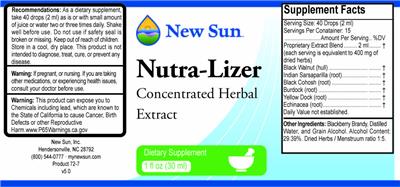
| Proprietary Extract BlendProprietary Extract Blend Note: (each serving is equivalent to 400 mg of dried herbs) (Dried herbs/menstruum ratio 1:5.) | 2 mL | † |
| Black Walnut | † | |
| Indian Sarsaparilla | † | |
| Black Cohosh | † | |
| Burdock | † | |
| Yellow Dock | † | |
| Echinacea | † |
Other ingredients: Blackberry Brandy, distilled Water, Grain Alcohol
% Daily Values for: Adults and children 4 or more years of age.
Where this label comes from
An original label of the NIH's Dietary Supplement Label Database, entered there on 25 February 2021, shown here as it was entered. The NIH's record
General information
- Product name
- Nutra-Lizer Concentrated Herbal Extract
- Brand
- New Sun
- Barcode (UPC)
- 72-7
- Net contents
- 1 Fluid Ounce(s); 30 mL
- Market status
- On market
- DSLD ID
- 245316
Classification
Label statements
Directions: Recommendation: As a dietary supplement, take 40 drops (2 ml) as is or with small amount of juice or water two or three times daily. Shake well before use.
Precautions: All Other: Do not use if safety seal is broken or missing.
Precautions: Children: Keep out of reach of children.
Storage: Store in a cool, dry place.
Precautions: Pregnant or Nursing or Prescription Medications: Warning: If pregnant, or nursing. If you are taking other medications, or experiencing health issues, consult your doctor before use.
FDA Statement of Identity: Dietary Supplement
Formula: Contains: Alcohol content: 29.39%.
Precautions: All Other: Warning: This product can expose you to chemicals including lead, which are known to the State of California to cause cancer, birth defects or other reproductive harm. www.P65Warnings.ca.gov
Brand information
Distributor: New Sun, Inc., Hendersonville, NC
More labels from New Sun
Labels only: each label is shown as printed on the bottle, with no grades, rankings or advice. A label in this database is not an endorsement of the product. Read the label on the bottle you buy: makers change their formulas. Reverse Age Lab is not affiliated with, or endorsed by, the National Institutes of Health or its Office of Dietary Supplements. The original labels come from the NIH’s public-domain data; the labels since are read by us. Search the Dietary Supplement Label Database.