
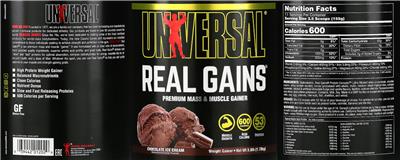
| Calories | 600 | |
| Total Fat | 6 g | 8% |
| Saturated Fat | 4 g | 20% |
| Trans Fat | 0 g | |
| Cholesterol | 100 mg | 33% |
| Sodium | 300 mg | 13% |
| Total Carbohydrates | 82 g | 30% |
| Dietary Fiber | 4 g | 16% |
| Total Sugars | 8 g | |
| Added Sugars | 4 g | 8% |
| Protein | 53 g | 106% |
| Vitamin D | 0 mcg | 0% |
| Calcium | 400 mg | 31% |
| Iron | 3.9 mg | 22% |
| Potassium | 480 mg | 10% |
| Phosphorus | 275 mg | 22% |
| Iodine | 40 mcg | 27% |
| Magnesium | 90 mg | 22% |
| Chloride | 240 mg | 10% |
Other ingredients: Maltodextrin, Real Gains Protein Complex, Cocoa, Inulin, Medium Chain Triglycerides, Calcium Caseinate, natural & artificial Chocolate Fudge and Vanilla flavors, Lecithin, Sodium Chloride, Flaxseed powder, Sucralose, Acesulfame Potassium
% Daily Values for: Adults and children 4 or more years of age.
Where this label comes from
An original label of the NIH's Dietary Supplement Label Database, entered there on 22 May 2021, shown here as it was entered. The NIH's record
General information
- Product name
- Real Gains Chocolate Ice Cream
- Brand
- Universal
- Barcode (UPC)
- 0 39442 01202 9
- Net contents
- 3.8 Pound(s); 1.73 kg
- Market status
- On market
- DSLD ID
- 247621
Classification
- Supplement form
- Powder
- Product type
- Other Combinations
- Claim types on the label
- Nutrient, All Other, Structure/Function
- Intended for
- Adult (18 - 50 Years)
Label statements
Formula: Contains: It was formulated with an ideal ratio of micronutrients, hand selected quality ingredients, superior amino acid profile, and great taste. Real Gains delivers both "slow" and "fast" proteins for optimal absorption, complex carbohydrates for energy, essential fats for all-around health, and a dose of fiber.
Formula: Contains: Balanced Macronutrients
Formula: Contains: Nutrient Dense Slow and Fast Releasing Proteins 600 Calories per Serving
Formulation: Does NOT Contain: GF Gluten Free
Formula: Contains: High Calorie Protein
Precautions: Allergies: Contains: Milk, soy. Made in a GMP facility on equipment that processes milk, soy, egg, peanuts, tree nuts, fish, shellfish, and wheat.
Directions: Dosage: Mix 3.5 scoops with 12-16 oz of your beverage of choice. For additional calories, you can add whole milk and other foods such as peanut butter, oatmeal, bananas and the like.
Precautions: Children: Warning: Not for use by those under the age of 18.
Precautions: All Other: Consult a physician before using this product. Athletes should consult with their sanctioning authority before use. California residents: Warning: Reproductive harm - www.P65Warnings.ca.gov.
Storage: Store product in a cool, dry place, away from heat, moisture and sunlight.
Formula: Contains: Typical Amino Acid Profile Per 100g of protein Essential Amino Acids L-Leucine (Branched Chain Amino Acid) 10740 mg L-Isoleucine (Branched Chain Amino Acid) 6100 mg L-Valine (Branched Chain Amino Acid) 5730 mg L-Threonine 6320 mg L-Lysine 8940 mg L-Phenylalanine 3430 mg L-Tryptophan 1690 mg L-Methionine 2100 mg L-Histidine 1980 mg L-Arginine (Condtionally essential amino acid) 2390 mg L-Aspartic Acid 10420 mg L-Alanine 4760 mg L-Glutamic Acid 12210 mg L-Glycine 1820 mg L-Tyrosine 3080 mg L-Serine 4720 mg L-Proline 5610 mg L-Cystine 2410 mg The amino acids in this product are naturally occurring from the protein sources. They are not added or manufactured.
Brand information
Manufacturer: Universal Nutrition, New Brunswick, New Jersey, USA
More labels from Universal
Labels only: each label is shown as printed on the bottle, with no grades, rankings or advice. A label in this database is not an endorsement of the product. Read the label on the bottle you buy: makers change their formulas. Reverse Age Lab is not affiliated with, or endorsed by, the National Institutes of Health or its Office of Dietary Supplements. The original labels come from the NIH’s public-domain data; the labels since are read by us. Search the Dietary Supplement Label Database.