
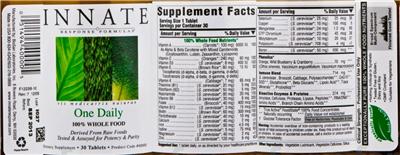
| 100% Whole Food Nutrients | ||
| Vitamin A (as as Alpha Carotene, & Beta-Carotene, with Mixed Carotenoids)Vitamin A (Form: as Alpha Carotene, & Beta Carotene, with Mixed Carotenoids (Form: Cryptoxanthin, Lutein, Zeaxanthin, Lycopene)) | 5,000 IU | 100% |
| Carrots | 100 mg | |
| Vitamin C | 60 mg | 100% |
| Oranges | 240 mg | |
| Vitamin D3 | 400 IU | 100% |
| S. cerevisiae | 8 mg | |
| Vitamin E (as Tocopherols, Tocotrienols) | 15 IU | 50% |
| Brown Rice | 60 mg | |
| Vitamin K | 65 mcg | 81% |
| Cabbage | 7 mg | |
| Thiamine (as Vitamin B1) | 5 mg | 333% |
| S. cerevisiae | 20 mg | |
| Riboflavin (as Vitamin B2) | 5 mg | 294% |
| S. cerevisiae | 50 mg | |
| Niacinamide | 20 mg | 100% |
| S. cerevisiae | 80 mg | |
| Vitamin B6 | 6 mg | 300% |
| S. cerevisiae | 30 mg | |
| Folate | 400 mcg | 100% |
| Broccoli | 40 mg | |
| Vitamin B12 | 15 mcg | 250% |
| S. cerevisiae | 3 mg | |
| Biotin | 300 mcg | 100% |
| Brown Rice | 60 mg | |
| Pantothenate | 10 mg | 100% |
| S. cerevisiae | 40 mg | |
| Calcium | 2 mg | <1% |
| S. cerevisiae | 40 mg | |
| Iron | 4.5 mg | 25% |
| S. cerevisiae | 90 mg | |
| Iodine | 75 mcg | 50% |
| S. cerevisiae | 5 mg | |
| Magnesium | 2 mg | <1% |
| S. cerevisiae | 40 mg | |
| Zinc | 6 mg | 40% |
| S. cerevisiae | 120 mg | |
| Selenium (as L-Selenomethionine) | 25 mcg | 36% |
| S. cerevisiae | 25 mg | |
| Copper | 100 mcg | 5% |
| S. cerevisiae | 10 mg | |
| Manganese | 1.2 mg | 60% |
| S. cerevisiae | 24 mg | |
| ChromiumGTF Chromium Note: Glucose tolerance factor | 45 mcg | 38% |
| S. cerevisiae | 23 mg | |
| Molybdenum | 20 mcg | 27% |
| S. cerevisiae | 10 mg | |
| Potassium | 4 mg | <1% |
| S. cerevisiae | 708 mg | |
| Boron | 500 mcg | † |
| S. cerevisiae | 50 mg | |
| Phenolics (as & Cranberry, Orange, Wild Blueberry)Phenolics (Form: Orange Genus: Citrus Species: sinensis, Wild Blueberry Genus: Vaccinium Species: angustifolium, & Cranberry Genus: Vaccinium Species: macrocarpon) | 70 mg | † |
| Immune Blend (as Beta Glucans, Broccoli, Cabbage, CoQ10, Glutathione, Lipoic Acid, Polysaccharides, Probiotics, S. cerevisiae, Superoxide Dismutase, Trace Minerals) | 714 mg | † |
| Bioactive Enzymes & Proteins (as Amino Acids, Amylase, Branch Chain Amino Acids, Cellulase, Lipase, Peptides, Protease, RNA/DNA) | 274 mg | † |
Other ingredients: Vegetable Lubricant, Vegetable Cellulose, Silica
% Daily Values for: Adults and children 4 or more years of age.
Where this label comes from
An original label of the NIH's Dietary Supplement Label Database, entered there on 23 August 2013, shown here as it was entered. The NIH's record
General information
- Product name
- One Daily
- Brand
- Innate Response Formulas
- Barcode (UPC)
- 0 51494 40000 5
- Net contents
- 30 Tablet(s)
- Market status
- On market
- DSLD ID
- 24764
Classification
- Supplement form
- Tablet or Pill
- Product type
- Other Combinations
- Claim types on the label
- All Other
- Intended for
- Vegetarian, Adult (18 - 50 Years), Gluten Free, Dairy Free
Label statements
Precautions: Children: Warning: Accidental overdose of iron-containing products is a leading cause of fatal poisoning in children under six. Keep this product out of reach of children. In case of accidental overdose, call a doctor or poison control center immediately.
FDA Statement of Identity: Dietary Supplement
Precautions: All Other: Clinical Strength - Professional Use Only
Formulation: Does NOT Contain: Free of Herbicides, Pesticides & Corn
Directions: Suggested Use: 1 tablet daily, or as directed by your healthcare practitioner.
Formulation: Does NOT Contain: - Nothing Artificial or Synthetic - Tested Free of Gluten, Dairy and Soy
Brand information
Manufactured by: BioSan Laboratories, Inc., Derry, NH
More labels from Innate Response Formulas
Labels only: each label is shown as printed on the bottle, with no grades, rankings or advice. A label in this database is not an endorsement of the product. Read the label on the bottle you buy: makers change their formulas. Reverse Age Lab is not affiliated with, or endorsed by, the National Institutes of Health or its Office of Dietary Supplements. The original labels come from the NIH’s public-domain data; the labels since are read by us. Search the Dietary Supplement Label Database.