
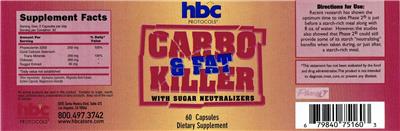
| Phaseolamin 2250 | 250 mg | 100% |
| Coral Calcium Selenium Trace Minerals | 200 mg | 100% |
| Chitosan | 200 mg | † |
| Guggul extract | 45 mg | † |
Other ingredients: Gymnema sylvestre, Magnolia Bark Extract, Gelatin Capsule, Magnesium Stearate
% Daily Values for: Adults and children 4 or more years of age.
Where this label comes from
An original label of the NIH's Dietary Supplement Label Database, entered there on 27 July 2021, shown here as it was entered. The NIH's record
General information
- Product name
- Carbo & Fat Killer
- Brand
- HBC Protocols
- Barcode (UPC)
- 6 79840 75160 3
- Net contents
- 60 Capsule(s)
- Market status
- On market
- DSLD ID
- 247908
Classification
- Supplement form
- Capsule
- Product type
- Other Combinations
- Claim types on the label
- All Other, Structure/Function
- Intended for
- Vegetarian, Adult (18 - 50 Years), Dairy Free, Sugar Free
Label statements
Formulation: Does NOT Contain: Contains no sugar, starch, yeast, artificial colors, preservatives or dairy products.
Precautions: Children: Keep out of the reach of children.
FDA Statement of Identity: Dietary Supplement
Directions: Directions for use: Recent research has shown the optimum time to take Phase 2 is just before a starch-rich meal along with 8 oz. of water. However, the studies also showed that Phase 2 could still provide some of its starch "neutralizing" benefits when taken during, or just after, a starch-rich meal.
Formula: Contains: Phase 2
Brand information
Manufacturer: hbc Protocols, Los Angeles, CA
More labels from HBC Protocols
Labels only: each label is shown as printed on the bottle, with no grades, rankings or advice. A label in this database is not an endorsement of the product. Read the label on the bottle you buy: makers change their formulas. Reverse Age Lab is not affiliated with, or endorsed by, the National Institutes of Health or its Office of Dietary Supplements. The original labels come from the NIH’s public-domain data; the labels since are read by us. Search the Dietary Supplement Label Database.