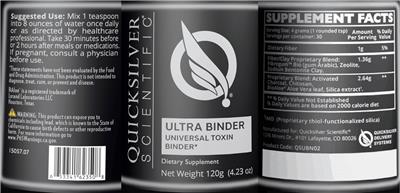
| Dietary Fiber | 1 g | 5% |
| Fiber/Clay Proprietary Blend | 1.36 g | † |
| Fibregum Bio (as Gum Arabic) | ||
| Zeolite | ||
| Sodium Bentonite Clay | ||
| Proprietary Blend | 2.64 g | † |
| Activated Charcoal | ||
| Chitosan | ||
| BioAloe Aloe vera | ||
| Silica extractSilica extract Note: IMD (proprietary thiol-functionalized silica) |
% Daily Values for: Adults and children 4 or more years of age.
Where this label comes from
An original label of the NIH's Dietary Supplement Label Database, entered there on 22 May 2021, shown here as it was entered. The NIH's record
General information
- Product name
- Ultra Binder
- Brand
- Quicksilver Scientific
- Barcode (UPC)
- 6 53341 62350 8
- Net contents
- 120 Gram(s); 4.23 Oz(s)
- Market status
- On market
- DSLD ID
- 248567
Classification
- Supplement form
- Powder
- Product type
- Other Combinations
- Claim types on the label
- All Other, Structure/Function
- Intended for
- Adult (18 - 50 Years)
Label statements
Directions: Suggested use: Mix 1 teaspoon into 8 ounces of water once daily or as directed by healthcare professional. Take 30 minutes before or 2 hours after meals or medications.
Precautions: Pregnant or Nursing or Prescription Medications: If pregnant, consult a physician before use.
Precautions: Pregnant or Nursing or Prescription Medications: Warning: This product can expose you to chemicals including lead, which is known to the State of California to cause birth defects or other reproductive harm. For more information go to www.P65Warnings.ca.gov.
FDA Statement of Identity: Dietary Supplement
Brand information
Manufactured for: Quicksilver Scientific, Lafayette, CO
More labels from Quicksilver Scientific
Labels only: each label is shown as printed on the bottle, with no grades, rankings or advice. A label in this database is not an endorsement of the product. Read the label on the bottle you buy: makers change their formulas. Reverse Age Lab is not affiliated with, or endorsed by, the National Institutes of Health or its Office of Dietary Supplements. The original labels come from the NIH’s public-domain data; the labels since are read by us. Search the Dietary Supplement Label Database.