
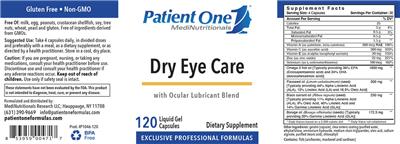
| Calories | 25 | |
| Total Fat | 3 g | 4% |
| Saturated Fat | 0.5 g | 3% |
| Monounsaturated Fat | 0.5 g | † |
| Polyunsaturated Fat | 1.5 g | † |
| Vitamin A (as Beta-Carotene, Vitamin A Palmitate)Vitamin A (Form: as Vitamin A Palmitate, Beta Carotene) | 900 mcg RAE | 100% |
| Vitamin C (as Ascorbic Acid) | 300 mg | 333% |
| Vitamin E (as D-Alpha-Tocopheryl Acetate)Vitamin E (Form: as D-Alpha Tocopheryl Acetate) | 20 mg | 133% |
| Zinc (as Zinc Oxide)Zinc (Form: as Zinc Oxide) | 25 mg | 227% |
| Selenium (as L-Selenomethionine)Selenium (Form: as L-Selenomethionine) | 100 mcg | 182% |
| Omega 3 Fish Oil (as and Docosahexaenoic Acid, typically providing Eicosapentaenoic Acid)Omega 3 Fish Oil (Form: typically providing 36% EPA (Alt. Name: Eicosapentaenoic Acid), and 24% DHA (Alt. Name: Docosahexaenoic Acid)) | 1,600 mg | † |
| Flaxseed Oil (as typically providing Alpha-Linolenic Acid, Linoleic Acid, and Oleic Acid)Flaxseed Oil (Form: typically providing 44% Alpha Linolenic Acid (Alt. Name: ALA), 15% Linoleic Acid (Alt. Name: LA), and 16.5% Oleic Acid) PlantPart: seed Genus: Linum Species: usitatissimum | 500 mg | † |
| Black Currant Oil (as typically providing Alpha-Linolenic Acid, and Gamma-Linolenic Acid, Linoleic Acid, Oleic Acid)Black Currant Oil (Form: typically providing 11% Alpha-Linolenic Acid (Alt. Name: ALA), 9% Oleic Acid, 40% Linoleic Acid, and 14% Gamma Linolenic Acid (Alt. Name: GLA)) PlantPart: seed Genus: Ribes Species: nigrum | 250 mg | † |
| Borage Oil (as typically providing Gamma-Linolenic Acid)Borage Oil (Form: typically providing 20% Gamma Linolenic Acid (Alt. Name: GLA)) PlantPart: seeds Genus: Borago Species: officinalis | 172.5 mg | † |
Other ingredients: Gelatin, Clear Enteric Coating, Chlorophyll
% Daily Values for: Adults and children 4 or more years of age.
Where this label comes from
An original label of the NIH's Dietary Supplement Label Database, entered there on 22 May 2021, shown here as it was entered. The NIH's record
General information
- Product name
- Dry Eye Care
- Brand
- Patient One 1 MediNutritionals
- Barcode (UPC)
- 8 53959 00471 7
- Net contents
- 120 Liquid Gel Capsule(s)
- Market status
- On market
- DSLD ID
- 249248
Classification
- Supplement form
- Capsule
- Product type
- Other Combinations
- Claim types on the label
- All Other, Structure/Function
- Intended for
- Adult (18 - 50 Years), Gluten Free, Dairy Free
Label statements
Formulation: Does NOT Contain: Gluten Free Non GMO Free of: milk, egg, peanuts, crustacean shellfish, soy, tree nuts, wheat, yeast and gluten. Free of ingredients derived from GMOs.
Directions: Suggested Use: Take 4 capsules daily, in divided doses and preferably with a meal, as a dietary supplement, or as directed by a health practitioner.
Storage: Store in a cool, dry place.
Precautions: Pregnant or Nursing or Prescription Medications: Caution: If you are pregnant, nursing, or taking any medications, consult your health practitioner before use.
Precautions: All Other: Discontinue use and consult your health practitioner if any adverse reactions occur.
Precautions: Children: Keep out of reach of children.
Precautions: All Other: Use only if safety seal is intact.
Formula: Contains: Dry Eye Care with Ocular lubricant blend
FDA Statement of Identity: Dietary Supplement
Precautions: Allergies: Contains: Fish (anchovies, mackerel and sardines)
Brand information
Formulated and Distributed By: MediNutritionals Research LLC, Hauppage, NY
More labels from Patient One 1 MediNutritionals
Labels only: each label is shown as printed on the bottle, with no grades, rankings or advice. A label in this database is not an endorsement of the product. Read the label on the bottle you buy: makers change their formulas. Reverse Age Lab is not affiliated with, or endorsed by, the National Institutes of Health or its Office of Dietary Supplements. The original labels come from the NIH’s public-domain data; the labels since are read by us. Search the Dietary Supplement Label Database.