
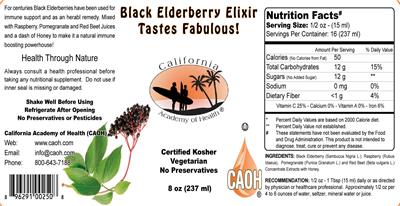
| CaloriesCalories Note: No Calories from Fat | 50 | |
| Total Carbohydrates | 12 g | 15% |
| SugarSugars Note: No added sugar | 12 g | † |
| Sodium | 0 mg | 0% |
| Dietary Fiber | <1 g | 4% |
| Vitamin C | 25% | |
| Calcium | 0% | |
| Vitamin A | 0% | |
| Iron | 6% |
Other ingredients: Black Elderberry concentrate extract, Raspberry concentrate extract, Pomegranate concentrate extract, Red Beet concentrate extract, Honey
% Daily Values for: Adults and children 4 or more years of age.
Where this label comes from
An original label of the NIH's Dietary Supplement Label Database, entered there on 23 August 2021, shown here as it was entered. The NIH's record
General information
- Product name
- Black Elderberry Elixir
- Brand
- California Academy of Health
- Barcode (UPC)
- 8 96291 00250 8
- Net contents
- 8 Ounce(s); 237 mL
- Market status
- On market
- DSLD ID
- 251187
Classification
Label statements
Formula: Contains: For centuries Black Elderberries have been used for immune support and as an herbal remedy. Mixed with Raspberry, Pomegranate and Red Beet Juices and a dash of Honey to make it a natural immune boosting powerhouse!
Precautions: All Other: Always consult a health professional before taking any nutritional supplement. Do not use if inner seal is missing or damaged.
Directions: Shake well before using
Storage: Refrigerate after using
Formulation: Does NOT Contain: No preservatives or pesticides
Formulation: Does NOT Contain: No preservatives
Directions: Recommendation: 1/2 oz - 1 Tbsp (15 ml) daily or as directed by physician or healthcare professional. Approximately 1/2 oz per 4 to 6 ounces of water, seltzer, mineral water or juice.
Brand information
Manufacturer: California Academy of Health (CAOH)
More labels from California Academy of Health
Labels only: each label is shown as printed on the bottle, with no grades, rankings or advice. A label in this database is not an endorsement of the product. Read the label on the bottle you buy: makers change their formulas. Reverse Age Lab is not affiliated with, or endorsed by, the National Institutes of Health or its Office of Dietary Supplements. The original labels come from the NIH’s public-domain data; the labels since are read by us. Search the Dietary Supplement Label Database.