
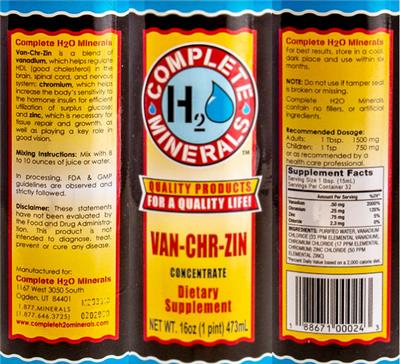
| Vanadium | 0.5 mg | 2,000% |
| Chromium | 0.25 mg | 125% |
| Zinc | 0.75 mg | 5% |
| Chloride | 2.3 mg | 0% |
Other ingredients: purified Water, Vanadium Chloride, Chromium Chloride, Zinc Chloride
% Daily Values for: Adults and children 4 or more years of age.
Where this label comes from
An original label of the NIH's Dietary Supplement Label Database, entered there on 27 July 2021, shown here as it was entered. The NIH's record
General information
- Product name
- Van-Chr-Zin Concentrate
- Brand
- Complete H2O Minerals
- Barcode (UPC)
- 1 88671 00024 3
- Net contents
- 16 Oz(s); 1 Pint(s); 473 mL
- Market status
- On market
- DSLD ID
- 252094
Classification
Label statements
Formula: Contains: Van-Chr-Zin is a blend of vanadium, which helps regulate HDL (good cholesterol) in the brain, spinal cord, and nervous system; chromium, which helps increase the body's sensitivity to the hormone insulin for efficient utilization of surplus glucose; and zinc, which is necessary for tissue repair and growth, as well as playing a key role in good vision.
Directions: Mixing Instructions: Mix with 8 to 10 ounces of juice or water.
FDA Statement of Identity: Dietary Supplement
Storage: For best results, store in a cool, dark place and use within six months.
Precautions: All Other: Note: Do not use if tamper seal is broken or missing.
Formulation: Does NOT Contain: Complete H2O Minerals contain no fillers, or artificial ingredients.
Directions: Recommended Dosage: Adults: 1 Tbsp. 1500 mg Children: 1 Tsp 750 mg or as recommended by a health care professional.
Brand information
Manufactured for: Complete H2O Minerals, Ogden, UT
More labels from Complete H2O Minerals
Labels only: each label is shown as printed on the bottle, with no grades, rankings or advice. A label in this database is not an endorsement of the product. Read the label on the bottle you buy: makers change their formulas. Reverse Age Lab is not affiliated with, or endorsed by, the National Institutes of Health or its Office of Dietary Supplements. The original labels come from the NIH’s public-domain data; the labels since are read by us. Search the Dietary Supplement Label Database.