
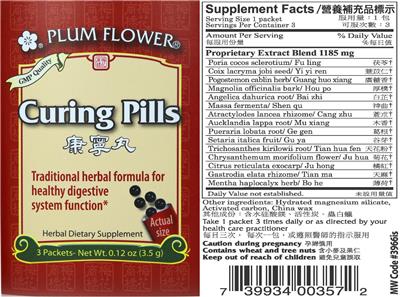
| Proprietary Extract Blend | 1,185 mg | |
| Poria cocos sclerotium extract | ||
| Coix lacryma jobi extract | ||
| Pogostemon cablin extract | ||
| Magnolia officinalis extract | ||
| Angelica dahurica extract | ||
| Massa fermenta extract | ||
| Atractylodes lancea extract | ||
| Aucklandia lappa extract | ||
| Pueraria lobata extract | ||
| Setaria italica extract | ||
| Trichosanthes kirilowii extract | ||
| Chrysanthemum morifolium extract | ||
| Citrus reticulata extract | ||
| Gastrodia elata extract | ||
| Mentha haplocalyx extract |
Other ingredients: hydrated Magnesium Silicate, activated Carbon, China Wax
% Daily Values for: Adults and children 4 or more years of age.
Where this label comes from
An original label of the NIH's Dietary Supplement Label Database, entered there on 24 September 2021, shown here as it was entered. The NIH's record
General information
- Product name
- Curing Pills
- Brand
- Plum Flower
- Barcode (UPC)
- 7 39934 00357 2
- Net contents
- 3 Packet(s); 0.12 Ounce(s); 3.5 Gram(s)
- Market status
- On market
- DSLD ID
- 252399
Classification
Label statements
FDA Statement of Identity: Herbal Dietary Supplement
Directions: Take 1 packet 3 times daily or as directed by your health care practitioner
Precautions: Pregnant or Nursing or Prescription Medications: Caution during pregnancy
Precautions: Allergies: Contains wheat and tree nuts
Precautions: Children: Keep out of reach of children
Brand information
Not Present: Mayway Corp
More labels from Plum Flower
Labels only: each label is shown as printed on the bottle, with no grades, rankings or advice. A label in this database is not an endorsement of the product. Read the label on the bottle you buy: makers change their formulas. Reverse Age Lab is not affiliated with, or endorsed by, the National Institutes of Health or its Office of Dietary Supplements. The original labels come from the NIH’s public-domain data; the labels since are read by us. Search the Dietary Supplement Label Database.