
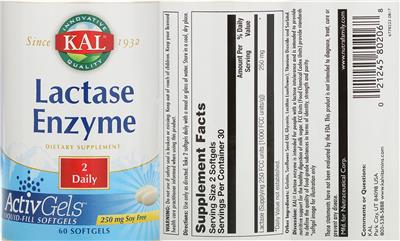
| Lactase | 250 mg | † |
Other ingredients: Gelatin, Sunflower seed Oil, Glycerin, Lecithin, Titanium Dioxide, Sorbitol
% Daily Values for: Adults and children 4 or more years of age.
Where this label comes from
An original label of the NIH's Dietary Supplement Label Database, entered there on 24 September 2021, shown here as it was entered. The NIH's record
General information
- Product name
- Lactase Enzyme 250 mg
- Brand
- KAL
- Barcode (UPC)
- 0 21245 80206 8
- Net contents
- 60 Softgel(s)
- Market status
- On market
- DSLD ID
- 254647
Classification
- Supplement form
- Softgel Capsule
- Product type
- Non-Nutrient/Non-Botanical
- Claim types on the label
- All Other, Structure/Function
- Intended for
- Adult (18 - 50 Years)
Label statements
FDA Statement of Identity: Dietary Supplement
Directions: 2 Daily
Formulation: Does NOT Contain: Soy free
Precautions: All Other: Warning: Do not use if safety seal is broken or missing.
Precautions: Children: Keep out of reach of children.
Precautions: All Other: Keep your licensed health care practitioner informed when using this product.
Directions: Directions: Use only as directed. Take 2 softgels daily with a meal or glass of water.
Storage: Store in a cool, dry place.
Formula: Contains: Discussion: KAL Lactase enzyme is intended for people with a lactose intolerance and is intended to provide nutritive support for the healthy digestion of milk sugar. FCC Units (Food Chemical Codex Units) provide standards to define the quality of food-grade substances in terms of identity, strength and purity.
Brand information
Manufacturer: KAL, Park City, UT, USA
Mfd. for: Nutraceutical Corp.
More labels from KAL
Labels only: each label is shown as printed on the bottle, with no grades, rankings or advice. A label in this database is not an endorsement of the product. Read the label on the bottle you buy: makers change their formulas. Reverse Age Lab is not affiliated with, or endorsed by, the National Institutes of Health or its Office of Dietary Supplements. The original labels come from the NIH’s public-domain data; the labels since are read by us. Search the Dietary Supplement Label Database.