
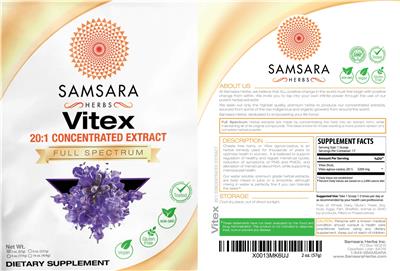
| Vitex | 3,200 mg | † |
% Daily Values for: Adults and children 4 or more years of age.
Where this label comes from
An original label of the NIH's Dietary Supplement Label Database, entered there on 22 October 2021, shown here as it was entered. The NIH's record
General information
- Product name
- Vitex 20:1 Concentrated Extract
- Brand
- Samsara Herbs
- Barcode (UPC)
- X0013MK6UJ
- Net contents
- 2 Oz(s); 57 Gram(s)
- Market status
- On market
- DSLD ID
- 255703
Classification
Label statements
FDA Statement of Identity: Dietary Supplement
Formulation: Does NOT Contain: Gluten Free Non-GMO
Formula: Contains: Description Chaste tree berry, or Vitex agnus-castus, is an herbal remedy used for thousands of years to optimize health in women. It is believed to support regulation of healthy and regular menstrual cycles, reduction of symptoms of PMS and PMDD, and alleviation of menstrual discomfort, while supporting menopausal health. Our water soluble, premium grade herbal extracts, are best mixed in juice or a smoothie, although mixing in water is perfectly fine if you can tolerate the taste.
Storage: Storage Cool dry place, out of direct sunlight.
Directions: Suggested Use: Take 1 scoop 1-3 times per day or as recommended by your health care professional.
Formulation: Does NOT Contain: Free of: Wheat, dairy, gluten, yeast, soy, nuts, eggs, fish, shellfish, animal or GMO by-products, fillers or preservatives.
Precautions: All Other: Caution: Persons with a known medical condition should consult a health care practitioner before using any dietary supplement.
Precautions: Children: Keep out of reach of children.
Brand information
Manufacturer: Samsara Herbs Inc., Clearfield, Utah
More labels from Samsara Herbs
Labels only: each label is shown as printed on the bottle, with no grades, rankings or advice. A label in this database is not an endorsement of the product. Read the label on the bottle you buy: makers change their formulas. Reverse Age Lab is not affiliated with, or endorsed by, the National Institutes of Health or its Office of Dietary Supplements. The original labels come from the NIH’s public-domain data; the labels since are read by us. Search the Dietary Supplement Label Database.