
| Calories | 630 | |
| Calories from Fat | 20 | |
| Total Fat | 2 g | 4% |
| Saturated Fat | 1 g | 5% |
| Trans Fat | 0 g | |
| Cholesterol | 30 mg | 10% |
| Sodium | 155 mg | 7% |
| Potassium | 150 mg | 4% |
| Total Carbohydrates | 127 g | 43% |
| Dietary Fiber | 3 g | 10% |
| Sugar | 10 g | |
| Protein | 26 g | 52% |
| Vitamin A | 19% | |
| Calcium | 65% | |
| Vitamin D | 38% | |
| Thiamine | 20% | |
| Niacin | 13% | |
| Folate | 13% | |
| Biotin | 13% | |
| Phosphorus | 25% | |
| Magnesium | 25% | |
| Copper | 30% | |
| Vitamin C | 17% | |
| Iron | 25% | |
| Vitamin E | 13% | |
| Riboflavin | 23% | |
| Vitamin B6 | 13% | |
| Vitamin B12 | 35% | |
| Pantothenic Acid | 13% | |
| Iodine | 25% | |
| Zinc | 15% | |
| Calories | 1,265 | |
| Calories from Fat | 40 | |
| Total Fat | 4.5 g | 7% |
| Saturated Fat | 2 g | 10% |
| Trans Fat | 0 g | |
| Cholesterol | 60 mg | 20% |
| Sodium | 310 mg | 13% |
| Potassium | 300 mg | 8% |
| Total Carbohydrates | 254 g | 85% |
| Dietary Fiber | 5 g | 20% |
| Sugar | 20 g | |
| Protein | 52 g | 104% |
| Vitamin A | 37% | |
| Calcium | 130% | |
| Vitamin D | 75% | |
| Thiamine | 40% | |
| Niacin | 25% | |
| Folate | 25% | |
| Biotin | 25% | |
| Phosphorus | 50% | |
| Magnesium | 50% | |
| Copper | 60% | |
| Vitamin C | 33% | |
| Iron | 50% | |
| Vitamin E | 25% | |
| Riboflavin | 45% | |
| Vitamin B6 | 25% | |
| Vitamin B12 | 70% | |
| Pantothenic Acid | 25% | |
| Iodine | 50% | |
| Zinc | 30% |
Other ingredients: Maltodextrin, cross flow ultra-micro filtered Whey Protein Concentrate, Fructose, Natural & Artificial flavors, dutched Cocoa, Calcium Caseinate, Vitamin & Mineral Blend, Whey Protein isolate, Creatine Monohydrate, L-Glutamine, Ace-K, Sucralose, Milk Protein isolate, Cellulose, Fibersol-2
% Daily Values for: Adults and children 4 or more years of age.
Where this label comes from
An original label of the NIH's Dietary Supplement Label Database, entered there on 24 September 2021, shown here as it was entered. The NIH's record
General information
- Product name
- Muscle Mass Gainer Chocolate
- Brand
- Labrada
- Barcode (UPC)
- 7 10779 57020 7
- Net contents
- 96 Ounce(s); 6 Pound(s); 2722 Gram(s)
- Market status
- On market
- DSLD ID
- 257756
Classification
- Supplement form
- Powder
- Product type
- Other Combinations
- Claim types on the label
- Nutrient, All Other, Structure/Function
- Intended for
- Adult (18 - 50 Years), Gluten Free
Label statements
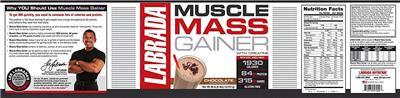
Formula: Contains: Muscle Mass Gainer contains a highly-concentrated 1930 calories, 84 grams of protein, and 315 grams of carbs when mixed with 32 oz of whole milk!
Formulation: Does NOT Contain: Muscle Mass Gainer contains no dextrose, sucrose, or corn syrup solids.
Directions: Muscle Mass Gainer can be used as a meal, or as a post-workout drink.
Formula: Contains: It's a high-calorie body building food fortified with muscle-building protein, carbohydrates, creatine and essential nutrients.
Formula: Contains: Muscle mass gainer with creatine With 32 oz whole milk: 1930 calories 84 g protein 315 g carbs
Formulation: Does NOT Contain: Gluten free
Formula: Contains: Chocolate Natural and artificial flavor
Precautions: Allergies: Contains Milk and Soy (Lecithin). Note: Soy lecithin helps the Muscle Mass Gainer powder to dissolve in water.
Directions: Directions: Add 9 scoops of Muscle Mass Gainer to 32 oz of milk or water, cover and blend until smooth. Or you may use the follow the bodyweight chart below: Bodyweight lbs, Daily whole food calories, Add (+) mass gainer calories, Recommended scoops 130-140 - 2700, 560, 4.0 150-160 - 3100, 630, 4.5 170-180 - 3500, 700, 5.0 190-200 - 3900, 770, 5.5 210+ - 4200, 840, 6.0 Muscle Mass Gainer may be taken right after a workout or any time of the day to increase protein and calorie intake.
Brand information
Developed by and Manufactured for: Labrada Nutrition, Houston, TX
More labels from Labrada
Labels only: each label is shown as printed on the bottle, with no grades, rankings or advice. A label in this database is not an endorsement of the product. Read the label on the bottle you buy: makers change their formulas. Reverse Age Lab is not affiliated with, or endorsed by, the National Institutes of Health or its Office of Dietary Supplements. The original labels come from the NIH’s public-domain data; the labels since are read by us. Search the Dietary Supplement Label Database.