
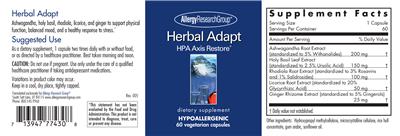
| Ashwagandha extract (as standardized to Withanolides) | 200 mg | † |
| Holy Basil extract (as standardized to Ursolic Acid) | 150 mg | † |
| Rhodiola extract (as and Salidrosides, standardized to total Rosavins) | 100 mg | † |
| Licorice extract (as standardized to Glycyrrhizic Acid) | 50 mg | † |
| Ginger extract (as standardized to Gingerols) | 25 mg | † |
Other ingredients: Hydroxypropyl Methylcellulose, Microcrystalline Cellulose, Rice hull concentrate, Gum Arabic, Sunflower Oil
% Daily Values for: Adults and children 4 or more years of age.
Where this label comes from
An original label of the NIH's Dietary Supplement Label Database, entered there on 18 December 2021, shown here as it was entered. The NIH's record
General information
- Product name
- Herbal Adapt
- Brand
- Allergy Research Group
- Barcode (UPC)
- 7 13947 77430 8
- Net contents
- 60 Vegetarian Capsule(s)
- Market status
- On market
- DSLD ID
- 258207
Classification
Label statements
Formula: Contains: Ashwagandha, holy basil, rhodiola, licorice, and ginger to support physical function, balanced mood, and a healthy response to stress.
Directions: Suggested Use As a dietary supplement, 1 capsule two times daily with or without food, or as directed by a healthcare practitioner. Best taken morning and noon.
Precautions: Pregnant or Nursing or Prescription Medications: Caution: Do not use if pregnant. Use only under the care of a qualified healthcare practitioner if taking antidepressant medications.
Storage: Keep in a cool, dry place, tightly capped.
FDA Statement of Identity: Dietary Supplement
Brand information
Formulated exclusively for: Allergy Research Group, South Salt Lake, UT
More labels from Allergy Research Group
Labels only: each label is shown as printed on the bottle, with no grades, rankings or advice. A label in this database is not an endorsement of the product. Read the label on the bottle you buy: makers change their formulas. Reverse Age Lab is not affiliated with, or endorsed by, the National Institutes of Health or its Office of Dietary Supplements. The original labels come from the NIH’s public-domain data; the labels since are read by us. Search the Dietary Supplement Label Database.