
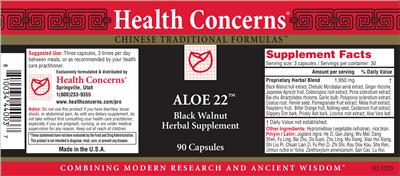
| Proprietary Herbal Blend | 1,950 mg | † |
| Black Walnut extract | ||
| Chebulic Myrobalan Aerial Extract | ||
| Ginger | ||
| Japanese Apricot fruit | ||
| Codonopsis root extract | ||
| Poria Sclerotium Extract | ||
| Bai-zhu Atractylodes | ||
| Garlic | ||
| Polyporus Sclerotium Extract | ||
| Costus | ||
| Fennel | ||
| Pomegranate fruit extract | ||
| Melia Fruit Extract | ||
| Raspberry | ||
| Bitter Orange | ||
| Nutmeg | ||
| Cardamom Fruit Extract | ||
| Slippery Elm Bark | ||
| Prickly Ash Bark | ||
| Licorice root extract | ||
| Aloe vera |
Other ingredients: Hypromellose, Rice Bran
% Daily Values for: Adults and children 4 or more years of age.
Where this label comes from
An original label of the NIH's Dietary Supplement Label Database, entered there on 22 January 2022, shown here as it was entered. The NIH's record
General information
- Product name
- Aloe 22
- Brand
- Health Concerns
- Barcode (UPC)
- 8 10034 44003 7
- Net contents
- 90 Capsule(s)
- Market status
- Off market
- DSLD ID
- 259153
Classification
Label statements
Directions: Suggested Use: Three capsules, 3 times per day between meals, or as recommended by your healthcare practitioner.
Precautions: All Other: Notice:DO not use this product if you have diarrhea, loose stools or abdominal pain.
Precautions: Pregnant or Nursing or Prescription Medications: As with any dietary supplement, do not take without first consulting your health care practitioner, especially if you are pregnant, nursing, or are under medical supervision for any reason.
Precautions: Children: Keep out of reach of children.
Brand information
Exclusively formulated & distributed by: Health Concerns, Springville, Utah
More labels from Health Concerns
Labels only: each label is shown as printed on the bottle, with no grades, rankings or advice. A label in this database is not an endorsement of the product. Read the label on the bottle you buy: makers change their formulas. Reverse Age Lab is not affiliated with, or endorsed by, the National Institutes of Health or its Office of Dietary Supplements. The original labels come from the NIH’s public-domain data; the labels since are read by us. Search the Dietary Supplement Label Database.