
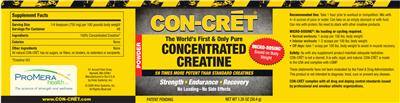
| Concentrated CreatineConcentrated Creatine Note: (Ingredients)(100%) | ||
| Calories | 0 None |
% Daily Values for: Adults and children 4 or more years of age.
Where this label comes from
An original label of the NIH's Dietary Supplement Label Database, entered there on 25 November 2011, shown here as it was entered. The NIH's record
General information
- Product name
- Concentrated Creatine Powder
- Brand
- CON-CRET
- Barcode (UPC)
- Not printed
- Net contents
- 1.35 oz.; 38.4 g
- Market status
- Off market
- DSLD ID
- 2608
Classification
- Supplement form
- Powder
- Product type
- Non-Nutrient/Non-Botanical
- Claim types on the label
- All Other, Structure/Function
- Intended for
- Adult (18 - 50 Years)
Label statements
Directions: MICRO-DOSING(R): No loading or cycling required. - Normal workouts: 1 scoop per 100 lbs. body weight . - Intense workouts: 1-2 scoops per 100 lbs. body weight. - Off days: take 1 scoop per 100 lbs. body weight to assist in muscle recovery.
Directions: Recommended Use: Take 1 hour prior to workout or competition. Mix with 4–6 ounces of juice or water. Can take on an empty stomach or with food. Can mix with protein. No need to stack with other creatine products.
Formulation: Does NOT Contain: All natural CON-CRET has no sugars, no fillers, no binders, no extenders or excipients.
Brand information
Manufacturer: Vireo Systems, Inc., Madison, TN, USA
More labels from CON-CRET
Labels only: each label is shown as printed on the bottle, with no grades, rankings or advice. A label in this database is not an endorsement of the product. Read the label on the bottle you buy: makers change their formulas. Reverse Age Lab is not affiliated with, or endorsed by, the National Institutes of Health or its Office of Dietary Supplements. The original labels come from the NIH’s public-domain data; the labels since are read by us. Search the Dietary Supplement Label Database.