
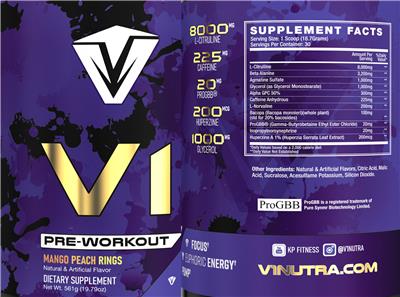
| L-Citrulline | 8,000 mg | † |
| Beta-Alanine | 3,200 mg | † |
| Agmatine Sulfate | 1,000 mg | † |
| Glycerol (as as Glycerol Monostearate) | 1,000 mg | † |
| Alpha-GlycerylphosphorylcholineAlpha GPC 50% | 300 mg | † |
| Caffeine Anhydrous | 225 mg | † |
| L-Norvaline | 200 mg | † |
| Bacopa monnieri (as Bacosides)std. for 20% bacosides | 100 mg | † |
| ProGBB (as Gamma-Butyrobetaine Ethyl Ester Chloride) | 20 mg | † |
| Isopropylnorsynephrine | 20 mg | † |
| Huperzine A (as Huperzia serrata Leaf Extract)Huperzine A 1% | 200 mcg | † |
Other ingredients: Natural & Artificial flavors, Citric Acid, Malic Acid, Sucralose, Acesulfame Potassium, Silicon Dioxide
% Daily Values for: Adults and children 4 or more years of age.
Where this label comes from
An original label of the NIH's Dietary Supplement Label Database, entered there on 22 October 2021, shown here as it was entered. The NIH's record · picture of the label (PDF)
General information
- Product name
- V1 Pre-Workout Mango Peach Rings
- Brand
- V1 Nutra
- Barcode (UPC)
- Not printed
- Net contents
- 561 Gram(s); 19.79 oz
- Market status
- On market
- DSLD ID
- 260876
Classification
- Supplement form
- Powder
- Product type
- Other Combinations
- Claim types on the label
- All Other
- Intended for
- Adult (18 - 50 Years)
Label statements
Formula: Contains: Mango Peach Rings Natural & Artificial Flavor
FDA Statement of Identity: Dietary Supplement
Formula: Contains: 8000 mg L-Citruline 225 mg Caffeine 20 g ProGBB 200 mcg Huperzine 1000 mg Glycerol
More labels from V1 Nutra
Labels only: each label is shown as printed on the bottle, with no grades, rankings or advice. A label in this database is not an endorsement of the product. Read the label on the bottle you buy: makers change their formulas. Reverse Age Lab is not affiliated with, or endorsed by, the National Institutes of Health or its Office of Dietary Supplements. The original labels come from the NIH’s public-domain data; the labels since are read by us. Search the Dietary Supplement Label Database.