
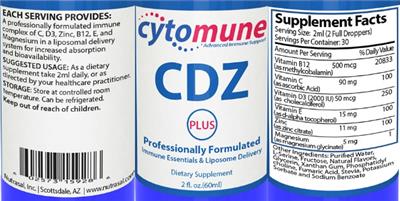
| Vitamin B12 (as Methylcobalamin) | 500 mcg | 20,833% |
| Vitamin C (as Ascorbic Acid) | 90 mg | 100% |
| Vitamin D3 (as Cholecalciferol)2000 IU | 50 mcg | 250% |
| Vitamin E (as Alpha-Tocopherol) | 15 mg | 100% |
| Zinc (as Zinc Citrate) | 11 mg | 100% |
| Magnesium (as Magnesium Glycinate) | 5 mg | 1% |
Other ingredients: Water, Purified, L-Serine, Fructose, Natural Flavors, Glycerin, Xanthan Gum, Phosphatidylcholine, Fumaric Acid, Stevia, Potassium Sorbate, Sodium Benzoate
% Daily Values for: Adults and children 4 or more years of age.
Where this label comes from
An original label of the NIH's Dietary Supplement Label Database, entered there on 23 February 2022, shown here as it was entered. The NIH's record · picture of the label (PDF)
General information
- Product name
- Cytomune CDZ Plus
- Brand
- Nutrasal
- Barcode (UPC)
- 6 02573 15928 6
- Net contents
- 2 Fluid Ounce(s); 60 Milliliter(s)
- Market status
- On market
- DSLD ID
- 261272
Classification
- Supplement form
- Liquid
- Product type
- Multi-Vitamin and Mineral (MVM)
- Claim types on the label
- Nutrient, All Other
- Intended for
- Adult (18 - 50 Years)
Label statements
Formula: Contains: Each Serving Provides: A professionally formulated immune complex of C, D3, Zinc, B12, E, and Magnesium in a liposomal delivery system for increased absorption and bioavailability.
Directions: Suggested Usage: As a dietary supplement take 2 ml daily, or as directed by your healthcare practitioner.
Storage: Storage: Store at controlled room temperature. Can be refrigerated.
Precautions: Children: Keep out of reach of children.
FDA Statement of Identity: Dietary Supplement
Brand information
Manufacturer: Nutrasal, Inc., Scottsdale, AZ
More labels from Nutrasal
Labels only: each label is shown as printed on the bottle, with no grades, rankings or advice. A label in this database is not an endorsement of the product. Read the label on the bottle you buy: makers change their formulas. Reverse Age Lab is not affiliated with, or endorsed by, the National Institutes of Health or its Office of Dietary Supplements. The original labels come from the NIH’s public-domain data; the labels since are read by us. Search the Dietary Supplement Label Database.