
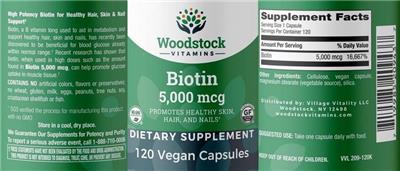
| Biotin | 5,000 mcg | 16,667% |
Other ingredients: Cellulose, Vegan Capsule, Magnesium Stearate, Silica
% Daily Values for: Adults and children 4 or more years of age.
Where this label comes from
An original label of the NIH's Dietary Supplement Label Database, entered there on 11 April 2022, shown here as it was entered. The NIH's record · picture of the label (PDF)
General information
- Product name
- Biotin 5,000 mcg
- Brand
- Woodstock Vitamins
- Barcode (UPC)
- 7 19985 20943 7
- Net contents
- 120 Vegan Capsule(s)
- Market status
- On market
- DSLD ID
- 262963
Classification
Label statements
Formula: Contains: High potency biotin for optimal beauty support Biotin, a B vitamin long used to aid in metabolism and support healthy hair, skin, and nails, has recently been discovered to be beneficial for blood glucose already within normal range. Recent research has also shown that biotin, when used in high doses such as the amount found in Biotin 5,000 mcg, can help promote glucose uptake in muscle tissue.
Formulation: Does NOT Contain: Contains no artificial colors, flavors or preservatives; no wheat, gluten, milk, eggs, peanuts, tree nuts, soy, crustacean shellfish or fish. SGS verified the process for manufacturing this product with no GMO
Storage: Store in a cool, dry place.
Precautions: All Other: To report a serious adverse event, call 1-888-710-0006
Formulation: Does NOT Contain: Non GMO ingredients
Formulation: Does NOT Contain: GF Gluten free
FDA Statement of Identity: Dietary Supplement
Directions: Suggested Use: Take one capsule daily with food.
Precautions: Children: Keep out of reach of children.
Brand information
Distributed by: Village Vitality LLC, Woodstock, NY
More labels from Woodstock Vitamins
Labels only: each label is shown as printed on the bottle, with no grades, rankings or advice. A label in this database is not an endorsement of the product. Read the label on the bottle you buy: makers change their formulas. Reverse Age Lab is not affiliated with, or endorsed by, the National Institutes of Health or its Office of Dietary Supplements. The original labels come from the NIH’s public-domain data; the labels since are read by us. Search the Dietary Supplement Label Database.