
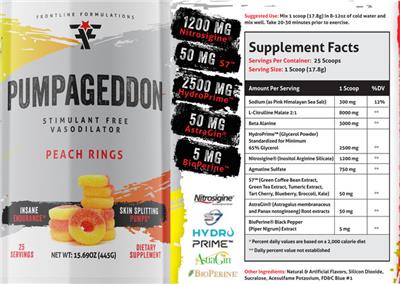
| Sodium (as as Pink Himalayan Sea Salt) | 300 mg | 12% |
| L-Citrulline Malate | 8,000 mg | † |
| Beta Alanine | 3,000 mg | † |
| Hydromax (as Glycerol, Powder)standardized minimum 65% Glycerol | 2,500 mg | † |
| Nitrosigine | 1,200 mg | † |
| Agmatine Sulfate | 750 mg | † |
| S7 (as Blueberry, Broccoli, Green Coffee bean extract, Green Tea extract, Kale, Tart Cherry, Turmeric extract) | 520 mg | † |
| AstraGin (as Astragalus membranaceous Root Extract, Panax notoginseng Root Extract) | 502 mg | † |
| Bioperine Black Pepper (Piper nigrum) extract | 5 mg | † |
Other ingredients: Natural & Artificial flavors, Silicon Dioxide, Sucralose, Acesulfame Potassium, FD&C Blue #1
% Daily Values for: Adults and children 4 or more years of age.
Where this label comes from
An original label of the NIH's Dietary Supplement Label Database, entered there on 11 April 2022, shown here as it was entered. The NIH's record · picture of the label (PDF)
General information
- Product name
- Pumpageddon Peach Rings
- Brand
- Frontline Formulations
- Barcode (UPC)
- Not printed
- Net contents
- 15.69 Ounce(s); 445 Gram(s)
- Market status
- On market
- DSLD ID
- 265384
Classification
- Supplement form
- Powder
- Product type
- Other Combinations
- Claim types on the label
- All Other, Structure/Function
- Intended for
- Adult (18 - 50 Years)
Label statements
Formulation: Does NOT Contain: Stimulant free
FDA Statement of Identity: Dietary Supplement
Formula: Contains: 1200 mg Nitrosigine 50 mg S7 2500 mg HydroPrime 50 mg AstraGin 5 mg BioPerine
Directions: Suggested Use: Mix 1 scoop (17.8 g) in 8-12 oz of cold water and mix well. Take 20-30 minutes prior to exercise.
Brand information
Manufacturer: Frontline Formulations
More labels from Frontline Formulations
Labels only: each label is shown as printed on the bottle, with no grades, rankings or advice. A label in this database is not an endorsement of the product. Read the label on the bottle you buy: makers change their formulas. Reverse Age Lab is not affiliated with, or endorsed by, the National Institutes of Health or its Office of Dietary Supplements. The original labels come from the NIH’s public-domain data; the labels since are read by us. Search the Dietary Supplement Label Database.