
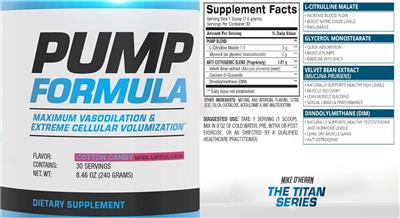
| Pump Blend | † | |
| L-Citrulline Malate 1:1 | 3 g | † |
| Glycerol (as as Glycerol Monostearate) | 2 g | † |
| Anti-Estrogenic Proprietary Blend | 1.01 mg | † |
| Velvet Bean extract | † | |
| Calcium D-Glucarate | † | |
| Diindolylmethane | † |
Other ingredients: Natural & Artificial Flavors, Citric Acid, Silica, Sucralose, Acesulfame-K, Maltodextrin
% Daily Values for: Adults and children 4 or more years of age.
Where this label comes from
An original label of the NIH's Dietary Supplement Label Database, entered there on 11 April 2022, shown here as it was entered. The NIH's record · picture of the label (PDF)
General information
- Product name
- Pump Formula Cotton Candy
- Brand
- BPI Sports
- Barcode (UPC)
- Not printed
- Net contents
- 8.46 Ounce(s); 240 Gram(s)
- Market status
- On market
- DSLD ID
- 265872
Classification
- Supplement form
- Powder
- Product type
- Other Combinations
- Claim types on the label
- Structure/Function
- Intended for
- Adult (18 - 50 Years)
Label statements
FDA Statement of Identity: Dietary Supplement
Directions: Suggested Use: Take 1 serving (1 scoop), mix in 8 oz of cold water, pre, intra or post exercise, or as directed by a qualified healthcare practitioner.
Formula: Contains: L-Citrulline Malate Increase blood flow Boost nitric oxide levels Endurance Glycerol Monostearate Quick absorption Muscle pumps Exercise efficiency Velvet bean extract (mucuna pruriens) Naturally supports healthy hgh levels Muscle recovery Lean muscle building Sexual libido & performance Dindolylmethane (DIM) Naturally supports healthy testosterone and hormone levels Lean, dry muscle gains Anti-Estrogenic
Brand information
Manufacturer: BPI
More labels from BPI Sports
Labels only: each label is shown as printed on the bottle, with no grades, rankings or advice. A label in this database is not an endorsement of the product. Read the label on the bottle you buy: makers change their formulas. Reverse Age Lab is not affiliated with, or endorsed by, the National Institutes of Health or its Office of Dietary Supplements. The original labels come from the NIH’s public-domain data; the labels since are read by us. Search the Dietary Supplement Label Database.