
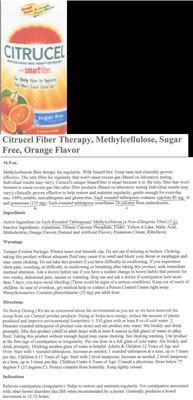
| MethylcelluloseMethylcellulose Note: a Non-Allergenic Fiber | 2 g |
Other ingredients: Aspartame, Dibasic Calcium Phosphate, FD&C Yellow 6 Lake, Malic Acid, Maltodextrin, Orange Flavors, Potassium Citrate, Riboflavin
% Daily Values for: Adults and children 4 or more years of age.
Where this label comes from
An original label of the NIH's Dietary Supplement Label Database, entered there on 25 October 2013, shown here as it was entered. The NIH's record
General information
- Product name
- Citrucel With Smartfiber Orange Flavor
- Brand
- GlaxoSmithKline
- Barcode (UPC)
- Not printed
- Net contents
- 16.9 oz.
- Market status
- On market
- DSLD ID
- 26748
Classification
- Supplement form
- Powder
- Product type
- Non-Nutrient/Non-Botanical
- Claim types on the label
- Nutrient, All Other
- Intended for
- Children 4 or More Years of Age, Adult (18 - 50 Years), No Allergies, Gluten Free, Sugar Free
Label statements
Formula: Contains: METHYLCELLULOSE FIBER THERAPY FOR REGULARITY
Directions: Directions No Scoop Dosing (We are as concerned about the environment as you are so we have removed the scoop from our Citrucel powder products. Doing so helps save energy, reduce the amount of plastic produced and improve environmental footprints): 1. Fill glass with at least 8 oz of cold water. 2. Measure rounded tablespoon of product (one dose) and stir product into water. Stir briskly and drink promptly. Mix this product (child or adult dose) with at least 8 ounces (a full glass) of water or other fluid. Taking this product without enough liquid may cause choking. See choking warning. Use product at the first sign of constipation or irregularity. Put one dose in a full glass of cold water. Stir briskly and drink promptly. Drinking another glass of water is helpful. Adults & Children 12 Years of Age and Over: Start with 1 rounded tablespoon. Increase as needed, 1 rounded tablespoon at a time, up to 3 times per day. Children 6-11 Years of Age: Start with 2 level teaspoons. Increase as needed, 2 level teaspoons at a time, up to 3 times per day.
Formula: Contains: Each rounded tablespoon contains: calcium 85 mg and potassium (125 mg). Each rounded tablespoon contributes 24 calories from maltodextrin.
Precautions: Children: Children Under 6 Years of Age: Consult a physician.
Storage: Store below 77 degrees F (25 degrees C). Protect contents from humidity. Keep tightly closed.
Formulation: Does NOT Contain: sugar free
Formula: Contains: Methylcellulose fiber therapy for regularity. With SmartFiber.
Formulation: Does NOT Contain: 100% soluble, non-allergenic and gluten-free.
Precautions: All Other: Warnings Tamper Evident Package: Printed inner seal beneath cap. Do not use if missing or broken.
Precautions: All Other: Choking: taking this product without adequate fluid may cause it to swell and block your throat or esophagus and may cause choking. Do not take this product if you have difficulty in swallowing. If you experience chest pain, vomiting, or difficulty in swallowing or breathing after taking this product, seek immediate medical attention. Ask a doctor before use if you have a sudden change in bowel habits that persists for two weeks; abdominal pain, nausea or vomiting. Stop use and ask a doctor if constipation lasts more than 7 days; you have rectal bleeding (These could be signs of a serious condition).
Precautions: Children: Keep out of reach of children.
Precautions: All Other: In case of overdose, get medical help or contact a Poison Control Center right away.
Formula: Contains: Phenylketonurics: Contains phenylalanine (52 mg) per adult dose.
Precautions: Allergies: Phenylketonurics: Contains phenylalanine (52 mg) per adult dose.
Brand information
Not Present: GlaxoSmithKline Consumer Healthcare Inc.
More labels from GlaxoSmithKline
Labels only: each label is shown as printed on the bottle, with no grades, rankings or advice. A label in this database is not an endorsement of the product. Read the label on the bottle you buy: makers change their formulas. Reverse Age Lab is not affiliated with, or endorsed by, the National Institutes of Health or its Office of Dietary Supplements. The original labels come from the NIH’s public-domain data; the labels since are read by us. Search the Dietary Supplement Label Database.