
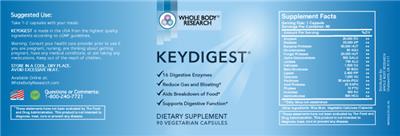
| Amylase20,000 DU | ||
| Diastase20,000 DP | ||
| Bacterial Protease50,000 HUT | ||
| Glucoamylase50 AGU | ||
| Fungal Protease20,000 HUT | ||
| Alpha-Galactosidase500 GALU | ||
| Lactase750 ALU | ||
| Cellulase1500 CU | ||
| Beta-Glucanase50 BGU | ||
| Lipase2400 FIP | ||
| Xylanase1000 XU | ||
| Pectinase50 endo-PGU | ||
| Acid Protease20 SAPU | ||
| Phytase10 FTU | ||
| Invertase500 SU | ||
| Hemicellulase500 HCU |
Other ingredients: Rice Bran, Vegetable Cellulose
% Daily Values for: Adults and children 4 or more years of age.
Where this label comes from
An original label of the NIH's Dietary Supplement Label Database, entered there on 16 June 2022, shown here as it was entered. The NIH's record · picture of the label (PDF)
General information
- Product name
- Keydigest
- Brand
- Whole Body Research
- Barcode (UPC)
- Not printed
- Net contents
- 90 Vegetarian Capsule(s)
- Market status
- On market
- DSLD ID
- 268855
Classification
- Supplement form
- Capsule
- Product type
- Non-Nutrient/Non-Botanical
- Claim types on the label
- All Other, Structure/Function
- Intended for
- Adult (18 - 50 Years)
Label statements
Directions: Suggested Use: Take 1-2 capsules with your meals.
Precautions: Pregnant or Nursing or Prescription Medications: Warning: Consult your health care provider prior to use if you are pregnant, nursing, are thinking about getting pregnant, have any medical conditions, or are taking any medications.
Precautions: Children: Keep out of the reach of children.
Storage: Store in a cool, dry place. Avoid excessive heat.
FDA Statement of Identity: Dietary Supplement
Brand information
Distributed by: Whole Body Research, Chatsworth, CA
More labels from Whole Body Research
Labels only: each label is shown as printed on the bottle, with no grades, rankings or advice. A label in this database is not an endorsement of the product. Read the label on the bottle you buy: makers change their formulas. Reverse Age Lab is not affiliated with, or endorsed by, the National Institutes of Health or its Office of Dietary Supplements. The original labels come from the NIH’s public-domain data; the labels since are read by us. Search the Dietary Supplement Label Database.