
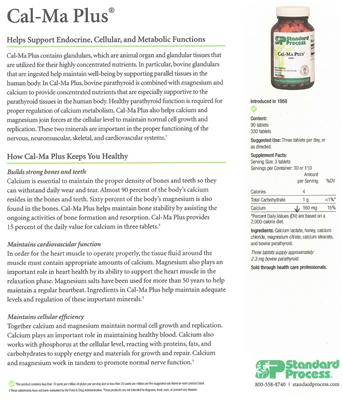
| Calories | 4 {Calories} | |
| Total Carbohydrates | 1 g | <1% |
| Calcium | 160 mg | 15% |
Other ingredients: Calcium Lactate, Honey, Calcium Chloride, Magnesium Citrate, Calcium Stearate, Bovine Parathyroid
% Daily Values for: Adults and children 4 or more years of age.
Where this label comes from
An original label of the NIH's Dietary Supplement Label Database, entered there on 25 November 2013, shown here as it was entered. The NIH's record
General information
- Product name
- Cal-Ma Plus
- Brand
- SP Standard Process
- Barcode (UPC)
- Not printed
- Net contents
- 330 Tablet(s)
- Market status
- On market
- DSLD ID
- 26906
Classification
- Supplement form
- Tablet or Pill
- Product type
- Mineral
- Claim types on the label
- Structure/Function
- Intended for
- Adult (18 - 50 Years), Gluten Free
Label statements
Formula: Contains: Three tablets supply approximately: 2.3 mg bovine parathyroid.
Formula: Contains: Helps Support Endocrine, Cellular, and Metabolic Functions Cal-Ma Plus contains glandulars, which are animal organ and glandular tissues that are utilized for their highly concentrated nutrients. In particular, bovine glandulars that are ingested help maintain well-being by supporting parallel tissues in the human body. In Cal-Ma Plus, bovine parathyroid is combined with magnesium and calcium to provide concentrated nutrients that are especially supportive to the parathyroid tissues in the human body.
Formula: Contains: Cal-Ma Plus provides 15 percent of the daily value for calcium in three tablets.
FDA Statement of Identity: Dietary Supplement
Directions: Suggested Use: Three tablets per day, or as directed.
Brand information
Manufacturer: Standard Process(R)
More labels from SP Standard Process
Labels only: each label is shown as printed on the bottle, with no grades, rankings or advice. A label in this database is not an endorsement of the product. Read the label on the bottle you buy: makers change their formulas. Reverse Age Lab is not affiliated with, or endorsed by, the National Institutes of Health or its Office of Dietary Supplements. The original labels come from the NIH’s public-domain data; the labels since are read by us. Search the Dietary Supplement Label Database.