
| High Mallow | 750 mg | † |
| Cassia angustifolia | 375 mg | † |
| Sage | 375 mg | † |
Other ingredients: Mallow, Wild, Cassia, Sage
% Daily Values for: Adults and children 4 or more years of age.
Where this label comes from
An original label of the NIH's Dietary Supplement Label Database, entered there on 22 September 2022, shown here as it was entered. The NIH's record · picture of the label (PDF)
General information
- Product name
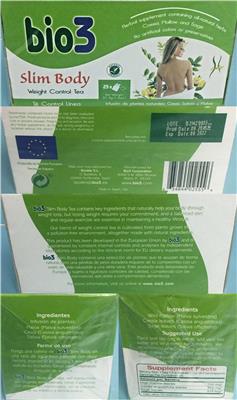
- Slim Body Weight Control Tea
- Brand
- Bio3
- Barcode (UPC)
- 6 34844 02555 6
- Net contents
- 37.5 Gram(s); 1.3 Oz(s); 25 Tea Bag(s)
- Market status
- On market
- DSLD ID
- 270389
Classification
- Supplement form
- Other (e.g. tea bag)
- Product type
- Botanical
- Claim types on the label
- All Other, Structure/Function
- Intended for
- Adult (18 - 50 Years), Women (not pregnant or lactating)
Label statements
Formula: Contains: Herbal supplement containing all-natural herbs Cassia, Mallow and Sage.
Formulation: Does NOT Contain: No artificial colors or preservatives
Precautions: Pregnant or Nursing or Prescription Medications: Pregnancy and lactation: As with any herbal supplement, do not use during pregnancy or lactation without the advice of a doctor or pharmacist.
Directions: Suggested Use Place one tea bag in a cup, add very hot water and let it steep for 3 minutes. We recommend one bag a day, preferably after dinner.
Precautions: Children: Should not be consumed by children, pregnant women or people with intestinal conditions.
Precautions: Pregnant or Nursing or Prescription Medications: Should not be consumed by children, pregnant women or people with intestinal conditions.
Brand information
Manufactured for: Bio3 Corporation, Miami, FL
Labels only: each label is shown as printed on the bottle, with no grades, rankings or advice. A label in this database is not an endorsement of the product. Read the label on the bottle you buy: makers change their formulas. Reverse Age Lab is not affiliated with, or endorsed by, the National Institutes of Health or its Office of Dietary Supplements. The original labels come from the NIH’s public-domain data; the labels since are read by us. Search the Dietary Supplement Label Database.