
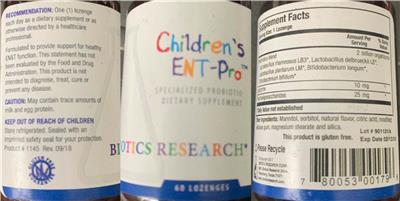
| Proprietary Blend2 billion organisms | ||
| Lactobacillus rhamnosus LB-3 | † | |
| Lactobacillus delbrueckii LE | † | |
| Lactobacillus plantarum LM | † | |
| Bifidobacterium longum | † | |
| Bifidobacterium bifidum | † | |
| Lysozyme | 10 mg | † |
| Fructooligosaccharides | 25 mg | † |
Other ingredients: Mannitol, Sorbitol, Natural flavor, Citric Acid, modified Cellulose Gum, Magnesium Stearate, Silica
% Daily Values for: Adults and children 4 or more years of age.
Where this label comes from
An original label of the NIH's Dietary Supplement Label Database, entered there on 16 June 2022, shown here as it was entered. The NIH's record · picture of the label (PDF)
General information
- Product name
- Children's ENT-Pro
- Brand
- Biotics Research
- Barcode (UPC)
- 7 80053 00179 6
- Net contents
- 60 Lozenge(s)
- Market status
- On market
- DSLD ID
- 270393
Classification
- Supplement form
- Lozenge
- Product type
- Other Combinations
- Claim types on the label
- All Other, Structure/Function
- Intended for
- Children 4 or More Years of Age, Gluten Free
Label statements
Directions: Recommendation: One (1) lozenge each day as a dietary supplement or as otherwise directed by a healthcare professional.
Precautions: Allergies: Caution: May contain trace amounts of milk and egg protein.
Precautions: Children: Keep out of reach of children
Storage: Store refrigerated.
Precautions: All Other: Sealed with an imprinted safety seal for your protection.
FDA Statement of Identity: Dietary Supplement
Formulation: Does NOT Contain: This product is gluten free.
Brand information
Manufacturer: Biotics Research Corp., Rosenberg, TX
More labels from Biotics Research
Labels only: each label is shown as printed on the bottle, with no grades, rankings or advice. A label in this database is not an endorsement of the product. Read the label on the bottle you buy: makers change their formulas. Reverse Age Lab is not affiliated with, or endorsed by, the National Institutes of Health or its Office of Dietary Supplements. The original labels come from the NIH’s public-domain data; the labels since are read by us. Search the Dietary Supplement Label Database.