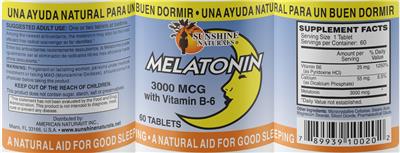
| Vitamin B6 (as Pyridoxine Hydrochloride) | 25 mg | 1,250% |
| Calcium (as Dicalcium Phosphate)Calcium (Form: as Dicalcium Phosphate) | 55 mg | 5.5% |
| Melatonin | 3,000 mcg | † |
Other ingredients: Microcrystalline Cellulose, Stearic Acid, Magnesium Stearate, Silicon Dioxide, Pharmaceutical Glaze
% Daily Values for: Adults and children 4 or more years of age.
Where this label comes from
An original label of the NIH's Dietary Supplement Label Database, entered there on 21 July 2022, shown here as it was entered. The NIH's record · picture of the label (PDF)
General information
- Product name
- Melatonin 3000 mcg with Vitamin B-6
- Brand
- Sunshine Naturals
- Barcode (UPC)
- 7 89939 10020 2
- Net contents
- 60 Tablet(s)
- Market status
- On market
- DSLD ID
- 271293
Classification
- Supplement form
- Tablet or Pill
- Product type
- Other Combinations
- Claim types on the label
- Nutrient, All Other, Structure/Function
- Intended for
- Adult (18 - 50 Years), Sugar Free
Label statements
Directions: Suggested adult use: One or two tablets at bedtime.
Formula: Contains: Among the newest antioxidants, the melatonin may also be the most efficient free radical scavenger so far identified.
Precautions: Pregnant or Nursing or Prescription Medications: Warning: Pregnant or lactating women, persons under medical treatment or taking MAO (Monoamine Oxidase), should consult a physician before taking this product.
Precautions: Children: Keep out of the reach of children.
Formulation: Does NOT Contain: This product does not contain sugar, starch, salt or preservatives.
Brand information
Distributed by: American Naturavit Inc., Miami, FL, U.S.A.
More labels from Sunshine Naturals
Labels only: each label is shown as printed on the bottle, with no grades, rankings or advice. A label in this database is not an endorsement of the product. Read the label on the bottle you buy: makers change their formulas. Reverse Age Lab is not affiliated with, or endorsed by, the National Institutes of Health or its Office of Dietary Supplements. The original labels come from the NIH’s public-domain data; the labels since are read by us. Search the Dietary Supplement Label Database.