
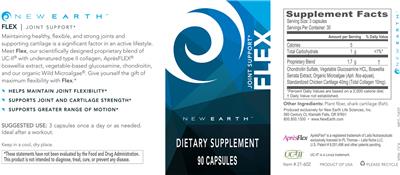
| Calories | 5 | |
| Total Carbohydrate | 1 g | <1% |
| Proprietary Blend | 1.7 g | † |
| Chondroitin Sulfate | ||
| Vegetable Glucosamine HCl | ||
| Boswellia serrata extract | ||
| organic Microalgae | ||
| standardized Chicken Cartilage | 40 mg | |
| Total Collagen | 10 mg |
Other ingredients: Plant Fiber, Shark Cartilage
% Daily Values for: Adults and children 4 or more years of age.
Where this label comes from
An original label of the NIH's Dietary Supplement Label Database, entered there on 23 August 2022, shown here as it was entered. The NIH's record · picture of the label (PDF)
General information
- Product name
- Flex
- Brand
- New Earth
- Barcode (UPC)
- Not printed
- Net contents
- 90 Capsule(s)
- Market status
- On market
- DSLD ID
- 271446
Classification
- Supplement form
- Capsule
- Product type
- Other Combinations
- Claim types on the label
- Nutrient, All Other, Structure/Function
- Intended for
- Adult (18 - 50 Years)
Label statements
Formula: Contains: Joint Support Maintaining healthy, flexible, and strong joints and supporting cartilage is a significant factor in an active lifestyle. Meet Flex, our scientifically designed proprietary blend of UC-II with undenatured type II collagen, ApresFLEX boswellia extract, vegetable-based glucosamine, chondroitin, and our organic Wild Microalgae. Give yourself the gift of maximum flexibility with Flex.
Directions: Suggested Use: 3 capsules once a day or as needed. Ideal after a workout.
Storage: Keep in a cool, dry place.
FDA Statement of Identity: Dietary Supplement
Brand information
Produced exclusively for: New Earth Life Sciences, Inc., Klamath Falls, OR
More labels from New Earth
Labels only: each label is shown as printed on the bottle, with no grades, rankings or advice. A label in this database is not an endorsement of the product. Read the label on the bottle you buy: makers change their formulas. Reverse Age Lab is not affiliated with, or endorsed by, the National Institutes of Health or its Office of Dietary Supplements. The original labels come from the NIH’s public-domain data; the labels since are read by us. Search the Dietary Supplement Label Database.