
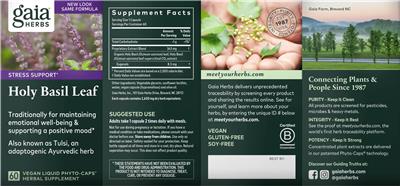
| Total Carbohydrate | <1 g | <1% |
| Proprietary Extract BlendProprietary Extract Blend Note: Each capsule contains 2,650 mg dry herb equivalent. | 363 mg | † |
| organic Holy Basil (Ocimum sanctum) leaf extract | ||
| Holy Basil (Ocimum sanctum) leaf supercritical CO2 extract | ||
| Eugenols | 8.5 mg | † |
Other ingredients: Vegetable Glycerin, Sunflower Lecithin, Water, vegan Capsule, Olive Oil
% Daily Values for: Adults and children 4 or more years of age.
Where this label comes from
An original label of the NIH's Dietary Supplement Label Database, entered there on 23 August 2022, shown here as it was entered. The NIH's record · picture of the label (PDF)
General information
- Product name
- Holy Basil Leaf
- Brand
- Gaia Herbs
- Barcode (UPC)
- Not printed
- Net contents
- 60 Vegan Liquid Phyto-Cap(s)(R)
- Market status
- Off market
- DSLD ID
- 272349
Classification
Label statements
Formula: Contains: Also known as Tulsi, an adaptogenic Ayurvedic herb
FDA Statement of Identity: Herbal Supplement
Formula: Contains: Each capsule contains 2,650 mg dry herb equivalent.
Directions: Suggested Use Adults take 1 capsules 2 times daily with meals.
Precautions: Pregnant or Nursing or Prescription Medications: Not for use during pregnancy or lactation. If you have a medical condition or take medications, please consult with your doctor before use.
Precautions: Children: Store away from children.
Precautions: All Other: Use only as directed on label. Safety-sealed for your protection.
Storage: Keep bottle capped at all times and store in a cool, dry place.
Formulation: Does NOT Contain: Gluten-free Soy-free
Brand information
Manufacturer: Gaia Herbs, Inc., Brevard, NC
More labels from Gaia Herbs
Labels only: each label is shown as printed on the bottle, with no grades, rankings or advice. A label in this database is not an endorsement of the product. Read the label on the bottle you buy: makers change their formulas. Reverse Age Lab is not affiliated with, or endorsed by, the National Institutes of Health or its Office of Dietary Supplements. The original labels come from the NIH’s public-domain data; the labels since are read by us. Search the Dietary Supplement Label Database.