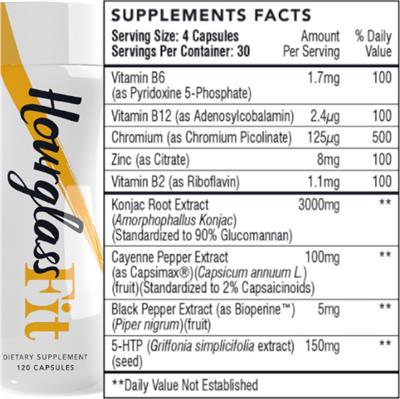
| Vitamin B6 (as as Pyridoxine 5-Phosphate) | 1.7 mg | 100% |
| Vitamin B12 (as as Adenosylcobalamin) | 2.4 mcg | 100% |
| Chromium (as as Chromium Picolinate) | 125 mcg | 500% |
| Zinc (as as Zinc Citrate) | 8 mg | 100% |
| Vitamin B-2 (as as Riboflavin) | 1.1 mg | 100% |
| Konjac Root Extract (as Glucomannan)Konjac Root Extract (Form: Glucomannan Note: Standardized to 90%) PlantPart: root Genus: Amorphophallus Species: konjac | 3,000 mg | † |
| Capsimax (as Cayenne Pepper Fruit Extract)Capsimax (Form: Cayenne Pepper Fruit Extract (Form: Capsaicinoids Note: Standardized to 2%) PlantPart: fruit Genus: Capsicum Species: annuum Classifier: L.) | 100 mg | † |
| BioPerine (as Black Pepper Fruit Extract) | 5 mg | † |
| 5-HTP (as Griffonia simplicifolia seed extract) | 150 mg | † |
% Daily Values for: Adults and children 4 or more years of age.
Where this label comes from
An original label of the NIH's Dietary Supplement Label Database, entered there on 22 September 2022, shown here as it was entered. The NIH's record · picture of the label (PDF)
General information
- Product name
- Hourglass Fit
- Brand
- Roar Ambition
- Barcode (UPC)
- Not printed
- Net contents
- 120 Capsule(s)
- Market status
- On market
- DSLD ID
- 272470
Classification
- Supplement form
- Capsule
- Product type
- Botanical with Nutrients
- Claim types on the label
- No Claim
- Intended for
- Adult (18 - 50 Years)
Label statements
FDA Statement of Identity: Dietary Supplement
Brand information
Manufacturer: Roar Ambition Ltd.
Labels only: each label is shown as printed on the bottle, with no grades, rankings or advice. A label in this database is not an endorsement of the product. Read the label on the bottle you buy: makers change their formulas. Reverse Age Lab is not affiliated with, or endorsed by, the National Institutes of Health or its Office of Dietary Supplements. The original labels come from the NIH’s public-domain data; the labels since are read by us. Search the Dietary Supplement Label Database.