
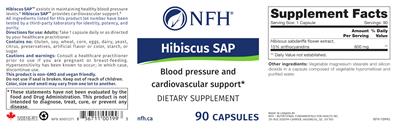
| Hibiscus sabdariffa Flower Extract (as Anthocyanidins)15% Anthocyanidins | 600 mg | † |
Other ingredients: Vegetable Magnesium Stearate, Silicon Dioxide, Vegetable Hypromellose, Water, Purified
% Daily Values for: Adults and children 4 or more years of age.
Where this label comes from
An original label of the NIH's Dietary Supplement Label Database, entered there on 23 January 2023, shown here as it was entered. The NIH's record · picture of the label (PDF)
General information
- Product name
- Hibiscus SAP
- Brand
- NFH
- Barcode (UPC)
- 8 56711 00199 3
- Net contents
- 90 Capsule(s)
- Market status
- On market
- DSLD ID
- 273322
Classification
Label statements
Formula: Contains: Hibiscus SAP assists in maintaining healthy blood pressure levels. Hibiscus SAP provides cardiovascular support.
Directions: Directions for use: Adults: Take 1 capsule daily or as directed by your healthcare practitioner.
Formulation: Does NOT Contain: Contains no: Gluten, soy, wheat, corn, eggs, dairy, yeast, citrus, preservatives, artificial flavor or color, starch, or sugar.
Precautions: Pregnant or Nursing or Prescription Medications: Cautions and warnings: Consult a healthcare practitioner prior to use if you are pregnant or breast-feeding.
Precautions: All Other: Hypersensitivity has been known to occur; in which case, discontinue use.
Formulation: Does NOT Contain: This product is non-GMO and vegan friendly.
Precautions: All Other: Do not use if seal is broken.
Precautions: Children: Keep out of reach of children.
FDA Statement of Identity: Dietary Supplement
Brand information
Made in Canada by: NFH - Nutritional Fundamentals for Health, Inc., Vaudreuil, QC
More labels from NFH
Labels only: each label is shown as printed on the bottle, with no grades, rankings or advice. A label in this database is not an endorsement of the product. Read the label on the bottle you buy: makers change their formulas. Reverse Age Lab is not affiliated with, or endorsed by, the National Institutes of Health or its Office of Dietary Supplements. The original labels come from the NIH’s public-domain data; the labels since are read by us. Search the Dietary Supplement Label Database.