
| Biotin | 5,000 mcg | 1,667% |
Other ingredients: Microcrystalline Cellulose, Dicalcium Phosphate, Croscarmellose Sodium, Stearic Acid, Magnesium Stearate, Silica
% Daily Values for: Adults and children 4 or more years of age.
Where this label comes from
An original label of the NIH's Dietary Supplement Label Database, entered there on 26 February 2014, shown here as it was entered. The NIH's record
General information
- Product name
- Biotin Trio
- Brand
- GNC Women's
- Barcode (UPC)
- 0 48107 12381 9
- Net contents
- N/A
- Market status
- On market
- DSLD ID
- 27477
Classification
- Supplement form
- Tablet or Pill
- Product type
- Vitamin
- Claim types on the label
- Nutrient, All Other, Structure/Function
- Intended for
- Adult Female (18 - 50 Years)
Label statements
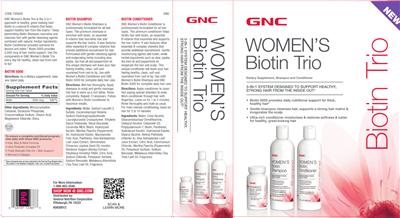
Formula: Contains: Biotin 5000 provides 5,000 mcg of hair matrix support.
Directions: Directions: As a dietary supplement, take one tablet daily.
Directions: To ensure a complete nutritional program, take daily with these GNC products: - Hair, Skin & Nails Formula - Ultra Probiotic Complex 25 - Triple Strength Fish Oil + Skin Support - Women's Collagen
Directions: Directions: Wet hair thoroughly. Apply shampoo to scalp and gently massage into hair to work up a rich lather. Rinse completely. Repeat, if necessary. Follow with Women's Biotin Conditioner to maximize results.
Directions: Directions: Apply conditioner to clean hair paying special attention to ends. Work conditioner through hair with fingertips. Leave on for 1 to 2 minutes. Rinse thoroughly & style as usual. For more intense conditioning, leave on for 5 to 10 minutes.
Brand information
Distributed by: General Nutrition Corporation, Pittsburgh, PA
More labels from GNC Women's
Labels only: each label is shown as printed on the bottle, with no grades, rankings or advice. A label in this database is not an endorsement of the product. Read the label on the bottle you buy: makers change their formulas. Reverse Age Lab is not affiliated with, or endorsed by, the National Institutes of Health or its Office of Dietary Supplements. The original labels come from the NIH’s public-domain data; the labels since are read by us. Search the Dietary Supplement Label Database.