
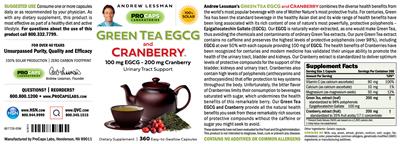
| Vitamin C (as Calcium Ascorbate) | 90 mg | 100% |
| Calcium (as Calcium Ascorbate) | 10 mg | 1% |
| Magnesium (as as Magnesium Oxide) | 50 mg | 12% |
| Green Tea Leaf Extract (as Polyphenols) | 200 mg | † |
| Epigallocatechin Gallate | 100 mg | |
| Cranberry Fruit Extract (as Fruit Acids) | 200 mg | † |
Other ingredients: Gelatin Capsule
% Daily Values for: Adults and children 4 or more years of age.
Where this label comes from
An original label of the NIH's Dietary Supplement Label Database, entered there on 24 October 2022, shown here as it was entered. The NIH's record · picture of the label (PDF)
General information
- Product name
- Green Tea EGCG and Cranberry
- Brand
- ProCaps Laboratories
- Barcode (UPC)
- 310979
- Net contents
- 360 Easy To Swallow Capsule(s)
- Market status
- On market
- DSLD ID
- 275262
Classification
- Supplement form
- Capsule
- Product type
- Other Combinations
- Claim types on the label
- All Other, Structure/Function
- Intended for
- Adult (18 - 50 Years), Gluten Free, Dairy Free, Sugar Free
Label statements
Directions: Suggested Use Consume one or more capsules daily or as recommended by your physician. As with any dietary supplement, this product is most effective as part of a healthy diet and active lifestyle. For questions about the use of this product call 800.332.7799.
Formula: Contains: 100 mg EGCG - 200 mg Cranberry
FDA Statement of Identity: Dietary Supplement
Formula: Contains: Andrew Lessman's Green Tea EGCG & Cranberry combines the diverse health benefits from the world's most popular beverage with one of Mother Nature's most protective fruits. For centuries, Green Tea has been the standard beverage in the healthy Asian diet and its wide range of health benefits have been long associated with its rich content of one of nature's most powerfully, protective polyphenols - Epigallocatechin Gallate (EGCG). Our EGCG is naturally water-extracted, as one would make Green Tea, thus avoiding the chemicals and contaminants of ordinary Green Tea Extracts. Our pure Green Tea extract contains no caffeine and preserves the highest levels of protective polyphenols (over 98%), including EGCG at over 50% with each capsule providing 100 mg of EGCG. The health benefits of Cranberries have been recognized for centuries and modern medicine has validated their unique ability to promote the health of the urinary tract, bladder and kidneys. Our Cranberry extract is standardized to deliver optimum levels of protective compounds for the support of the bladder, kidneys and urinary tract. Cranberries also contain high levels of polyphenols (anthocyanins and anthocyanidins) that offer protection to key systems throughout the body. Unfortunately, the bitter flavor of Cranberries limits their consumption to beverages saturated with sugar, which undermines the health benefits of this remarkable berry. Our Green Tea EGCG and Cranberry provide all the natural health benefits you seek from these remarkably rich sources of protective compounds without the caffeine or sugar you might seek to avoid.
Formulation: Does NOT Contain: Contains no additives or common allergens Contains no milk, soy, yeast, wheat, gluten, sodium, salt, sugar, fat, cholesterol, color, preservative, common allergens, genetically modified (GMO) ingredients or manufacturing additives.
Brand information
Manufacturer: ProCaps Laboratories, Henderson, NV
More labels from ProCaps Laboratories
Labels only: each label is shown as printed on the bottle, with no grades, rankings or advice. A label in this database is not an endorsement of the product. Read the label on the bottle you buy: makers change their formulas. Reverse Age Lab is not affiliated with, or endorsed by, the National Institutes of Health or its Office of Dietary Supplements. The original labels come from the NIH’s public-domain data; the labels since are read by us. Search the Dietary Supplement Label Database.