
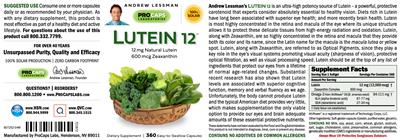
| LuteinLutein Note: 12,000 mcg | 12 mg | † |
| Zeaxanthin Complex | 600 mcg | |
| Omega-3 (as Ahiflower Seed Oil)94-111mg | 111 mg | † |
| Alpha-Linolenic AcidALA (Alt. Name: Alpha-Linolenic Acid) Note: (67-77 mg) (Omega-3) | 77 mg | |
| Stearidonic AcidSDA (Alt. Name: Stearidonic acid) Note: (27-34 mg) (Omega-3) | 34 mg |
Other ingredients: Soft-Gelatin Capsule
% Daily Values for: Adults and children 4 or more years of age.
Where this label comes from
An original label of the NIH's Dietary Supplement Label Database, entered there on 24 October 2022, shown here as it was entered. The NIH's record · picture of the label (PDF)
General information
- Product name
- Lutein 12
- Brand
- ProCaps Laboratories
- Barcode (UPC)
- 721672
- Net contents
- 360 Easy-To-Swallow Capsule(s)
- Market status
- Off market
- DSLD ID
- 275265
Classification
- Supplement form
- Capsule
- Product type
- Other Combinations
- Claim types on the label
- Nutrient, All Other, Structure/Function
- Intended for
- Adult (18 - 50 Years), Gluten Free, Dairy Free, Sugar Free
Label statements
Directions: Suggested Use Consume one or more capsules daily or as recommended by your physician. As with any dietary supplement, this product is most effective as part of a healthy diet and active lifestyle. For questions about the use of this product call 800.332.7799.
Formula: Contains: 12 mg Natural Lutein 600 mcg Zeaxanthin
FDA Statement of Identity: Dietary Supplement
Formula: Contains: Andrew Lessman's Lutein 12 is an ultra-high potency source of Lutein - A powerful, protective carotenoid that experts consider absolutely essential to healthy vision. Diets rich in lutein have long been associated with superior eye health; and more recently brain health. Lutein is most highly concentrated in the retina and macula of the eye where its unique structure allows it to protect these delicate tissues from high-energy radiation and oxidation. Lutein, along with Zeaxanthin, are so highly concentrated in the retina and macula that they provide both its color and its name, since the Latin name for the macula is the macula lutea or yellow spot. Lutein, along with Zeaxanthin, are referred to as optical pigments, since they play a key role in the eye’s visual systems promoting visual acuity (sharpness of vision), protective optical filtration, as well as visual processing speed. Lutein should be at the top of any list of ingredients to protect our eyes from a lifetime of normal age-related changes. Substantial recent research has also shown that lutein levels are associated with superior cognitive function, memory and verbal fluency as we age. Unfortunately, the body cannot produce lutein and the typical American diet provides very little, which makes supplementations the only viable option to provide our eyes and brain adequate amounts of these essential protective nutrients.
Formulation: Does NOT Contain: Contains no additives or common allergens
Formulation: Does NOT Contain: Contains no milk, soy, yeast, wheat, gluten, sodium, salt, sugar, cholesterol, color, preservative, common allergens, genetically modified (GMO) ingredients or manufacturing additives.
Precautions: Allergies: Contains no milk, soy, yeast, wheat, gluten, sodium, salt, sugar, fat, cholesterol, color, preservative, common allergens, genetically modified (GMO) ingredients or manufacturing additives.
Precautions: All Other: Always wear UV-protective sunglasses outdoors
Brand information
Manufactured by: ProCaps Laboratories, Henderson, NV
More labels from ProCaps Laboratories
Labels only: each label is shown as printed on the bottle, with no grades, rankings or advice. A label in this database is not an endorsement of the product. Read the label on the bottle you buy: makers change their formulas. Reverse Age Lab is not affiliated with, or endorsed by, the National Institutes of Health or its Office of Dietary Supplements. The original labels come from the NIH’s public-domain data; the labels since are read by us. Search the Dietary Supplement Label Database.