
| Vitamin C (as Ascorbyl Palmitate, Calcium Ascorbate)Vitamin C (Form: as Calcium Ascorbate, Ascorbyl Palmitate) | 100 mg | 111% |
| Resveratrol (as from Polygonum cuspidatum (root) extract)Resveratrol (Form: from Polygonum cuspidatum (root) extract PlantPart: root Genus: Polygonum Species: cuspidatum) | 100 mg | † |
Other ingredients: Gelatin Capsule
% Daily Values for: Adults and children 4 or more years of age.
Where this label comes from
An original label of the NIH's Dietary Supplement Label Database, entered there on 24 October 2022, shown here as it was entered. The NIH's record · picture of the label (PDF)
General information
- Product name
- Resveratrol 100
- Brand
- ProCaps Laboratories
- Barcode (UPC)
- 659572
- Net contents
- 360 Easy-To-Swallow Capsule(s)
- Market status
- Off market
- DSLD ID
- 275286
Classification
- Supplement form
- Capsule
- Product type
- Other Combinations
- Claim types on the label
- All Other, Structure/Function
- Intended for
- Adult (18 - 50 Years), Gluten Free, Dairy Free, Sugar Free
Label statements
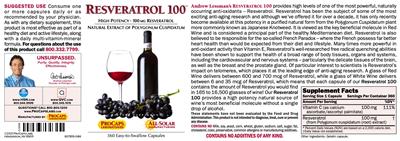
Directions: Suggested Use Consume one or more capsules daily or as recommended by your physician. As with any dietary supplement, this product is most effective as part of a healthy diet and active lifestyle, along with a daily multi-vitamin-mineral formula. For questions about the use of this product call 800.332.7799.
Formula: Contains: 100 mg resveratrol Natural extract of polygonum cuspidatum
FDA Statement of Identity: Dietary Supplement
Formula: Contains: Andrew Lessman’s Resveratrol 100 provides high levels of one of the most powerful, naturally occurring anti-oxidants – resveratrol. Resveratrol has been the subject of some of the most exciting anti-aging research and although we've offered it for over a decade, it has only recently become available at this potency in a purified natural form from the polygonum cuspidatum plant more commonly known as Japanese knotweed. It is viewed as the key beneficial molecule in red wine and is considered a principal part of the healthy Mediterranean diet. Resveratrol is also believed to be responsible for the so-called French Paradox – where the French possess far better heart health than would be expected from their diet and lifestyle. Many times more powerful in anti-oxidant activity than vitamin E, resveratrol's well-researched free radical quenching abilities have been shown to support the health of a broad range of body tissues, organs and systems, including the cardiovascular and nervous systems – particularly the delicate tissues of the brain, as well as the breast and the prostate gland. Of particular interest to scientists is resveratrol's impact on telomeres, which places it at the leading edge of anti-aging research. A glass of red wine delivers between 600 and 700 mcg of resveratrol, while a glass of white wine delivers between 6 and 35 mcg of resveratrol, which means that each capsule of our Resveratrol 100 contains the amount of resveratrol you would find in 165 to 16,500 glasses of wine! Our Resveratrol 100 provides a high potency natural source of wine's most beneficial molecule without a single drop of alcohol.
Formulation: Does NOT Contain: Contains no milk, soy, yeast, corn, wheat, gluten, sodium, salt, sugar, fat, cholesterol, color, preservative, common allergens or manufacturing additives. Contains no additives of any kind.
Brand information
Manufactured by: ProCaps Laboratories, Henderson, NV
More labels from ProCaps Laboratories
Labels only: each label is shown as printed on the bottle, with no grades, rankings or advice. A label in this database is not an endorsement of the product. Read the label on the bottle you buy: makers change their formulas. Reverse Age Lab is not affiliated with, or endorsed by, the National Institutes of Health or its Office of Dietary Supplements. The original labels come from the NIH’s public-domain data; the labels since are read by us. Search the Dietary Supplement Label Database.