
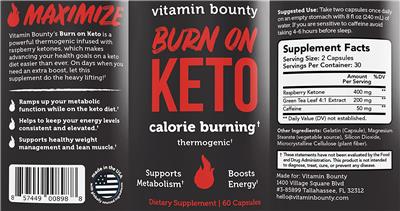
| Raspberry Ketone | 400 mg | † |
| Green Tea Leaf Extract4:1 | 200 mg | † |
| Caffeine | 50 mg | † |
Other ingredients: Gelatin, Magnesium Stearate, Silicon Dioxide, Microcrystalline Cellulose
% Daily Values for: Adults and children 4 or more years of age.
Where this label comes from
An original label of the NIH's Dietary Supplement Label Database, entered there on 23 August 2022, shown here as it was entered. The NIH's record · picture of the label (PDF)
General information
- Product name
- Burn On Keto
- Brand
- Vitamin Bounty
- Barcode (UPC)
- 8 57449 00898 8
- Net contents
- 60 Capsule(s)
- Market status
- On market
- DSLD ID
- 275576
Classification
- Supplement form
- Capsule
- Product type
- Other Combinations
- Claim types on the label
- All Other, Structure/Function
- Intended for
- Adult (18 - 50 Years)
Label statements
Formula: Contains: Vitamin Bounty's Burn on Keto is a powerful thermogenic infused with raspberry ketones, which makes advancing your health goals on a keto diet easier than ever. On days when you need an extra boost, let this supplement do the heavy lifting!
FDA Statement of Identity: Dietary Supplement
Directions: Suggested Use: Take two capsules once daily on an empty stomach with 8 fl oz (240 mL) of water. If you are sensitive to caffeine avoid taking 4-6 hours before sleep.
Brand information
Made for: Vitamin Bounty, Tallahassee, FL
More labels from Vitamin Bounty
Labels only: each label is shown as printed on the bottle, with no grades, rankings or advice. A label in this database is not an endorsement of the product. Read the label on the bottle you buy: makers change their formulas. Reverse Age Lab is not affiliated with, or endorsed by, the National Institutes of Health or its Office of Dietary Supplements. The original labels come from the NIH’s public-domain data; the labels since are read by us. Search the Dietary Supplement Label Database.