
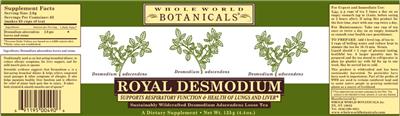
| Desmodium adscendens | 2 g | † |
Other ingredients: Desmodium adscendens
% Daily Values for: Adults and children 4 or more years of age.
Where this label comes from
An original label of the NIH's Dietary Supplement Label Database, entered there on 24 October 2022, shown here as it was entered. The NIH's record · picture of the label (PDF)
General information
- Product name
- Royal Desmodium Tea
- Brand
- Whole World Botanicals
- Barcode (UPC)
- 6 91195 00490 6
- Net contents
- 125 Gram(s); 4.4 Ounce(s)
- Market status
- On market
- DSLD ID
- 276176
Classification
- Supplement form
- Other (e.g. tea bag)
- Product type
- Botanical
- Claim types on the label
- All Other, Structure/Function
- Intended for
- Adult (18 - 50 Years)
Label statements
Formula: Contains: Desmodium adscendens
Formula: Contains: Sustainably wildcrafted desmodium adscendens loose tea
FDA Statement of Identity: A Dietary Supplement
Directions: For urgent and immediate use: Take 2-3 cups of tea 3 times a day on an empty stomach (up to 15 min. before eating or 2 hours after). If using this product for the first time, start with one cup twice a day. For maintenance: Take one cup of tea once or twice a day on an empty stomach or consult your health care practitioner. To prepare: Add 4 level tsp. of tea to 3 cups of boiling water and reduce heat to simmer the tea for 10-15 min. Strain. Liquid should = 2 cups of pleasant tasting, healthful tea. A larger quantity may be prepared and the tea stored in refrigerator in glass (or plastic) jar with lid for up to one week. May be served hot or cold.
Formulation: Does NOT Contain: No pesticides have been used in importation.
Brand information
Manufactured for: Whole World Botanicals, Inc., NY, NY
More labels from Whole World Botanicals
Labels only: each label is shown as printed on the bottle, with no grades, rankings or advice. A label in this database is not an endorsement of the product. Read the label on the bottle you buy: makers change their formulas. Reverse Age Lab is not affiliated with, or endorsed by, the National Institutes of Health or its Office of Dietary Supplements. The original labels come from the NIH’s public-domain data; the labels since are read by us. Search the Dietary Supplement Label Database.