
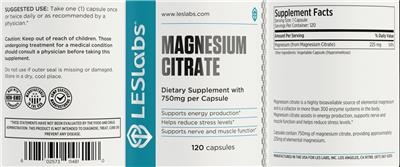
| Magnesium (as Magnesium Citrate) | 225 mg | 54% |
Other ingredients: Hypromellose
% Daily Values for: Adults and children 4 or more years of age.
Where this label comes from
An original label of the NIH's Dietary Supplement Label Database, entered there on 24 October 2022, shown here as it was entered. The NIH's record · picture of the label (PDF)
General information
- Product name
- Magnesium Citrate
- Brand
- LES Labs
- Barcode (UPC)
- 6 02573 11481 0
- Net contents
- 120 Capsule(s)
- Market status
- Off market
- DSLD ID
- 276523
Classification
Label statements
Directions: Suggested use: Take one (1) capsule once or twice daily or as recommended by a physician.
Precautions: Children: Caution: Keep out of reach of children.
Precautions: All Other: Those undergoing treatment for a medical condition should consult a physician before taking this supplement.
Precautions: All Other: Do not use if outer seal is missing or damaged.
Storage: Store in a dry, cool place.
Formulation: Does NOT Contain: Made with non-GMO ingredients
FDA Statement of Identity: Magnesium Citrate Dietary Supplement with 750mg per capsule
Formula: Contains: Magnesium Citrate Dietary Supplement with 750mg per capsule
Formula: Contains: Magnesium citrate is a highly bioavailable source of elemental magnesium and is a cofactor in more than 300 enzyme systems in the body. Magnesium citrate assists in energy production, supports nerve and muscle function and helps reduce stress levels. Capsules contain 750mg of magnesium site rate, providing approximately 225mg of elemental magnesium.
Brand information
Manufactured in the USA for: LES Labs, Inc., Los Angeles, CA
More labels from LES Labs
Labels only: each label is shown as printed on the bottle, with no grades, rankings or advice. A label in this database is not an endorsement of the product. Read the label on the bottle you buy: makers change their formulas. Reverse Age Lab is not affiliated with, or endorsed by, the National Institutes of Health or its Office of Dietary Supplements. The original labels come from the NIH’s public-domain data; the labels since are read by us. Search the Dietary Supplement Label Database.